

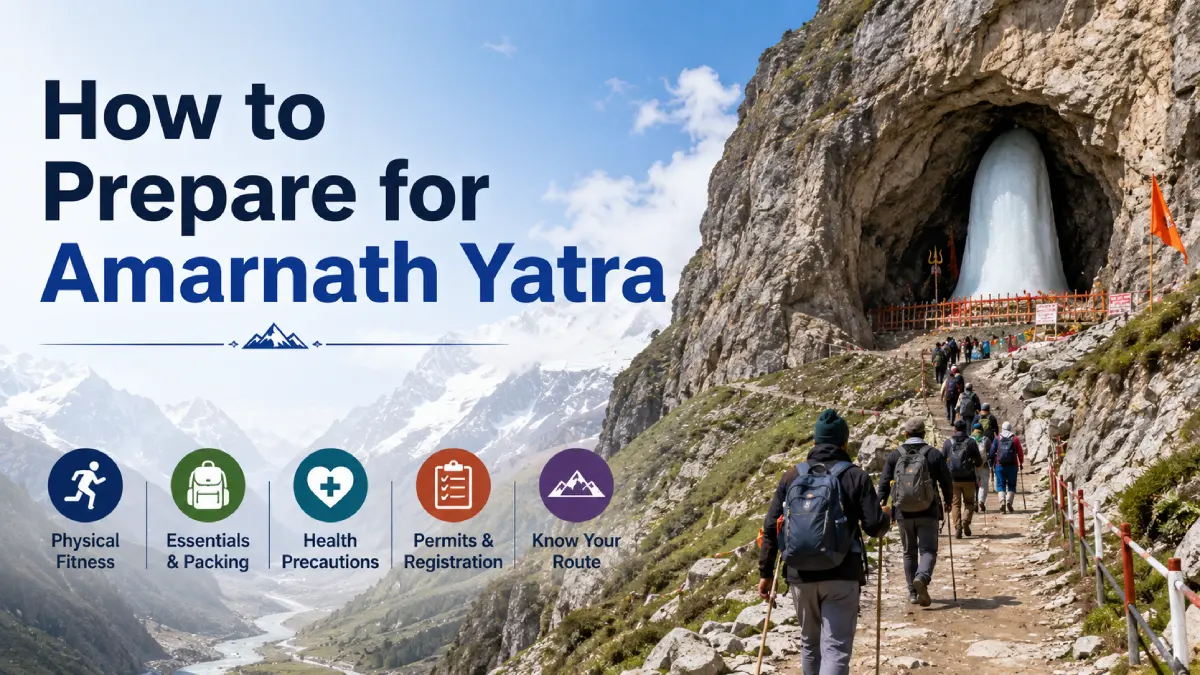
Everything you need to know- from registration and routes to packing, food, fitness, and divine darshan at 3,888 metres for Amarnath Yatra.

Historical Significance of the Holy Cave
Nestled at an altitude of 3,888 metres in the Lidder Valley of South Kashmir Himalayas, the Amarnath Cave is one of Hinduism’s 51 Shakti Peethas and among its most sacred shrines. The cave is naturally formed, roughly 40 metres high, and houses the legendary ice Shivlinga– a naturally formed ice stalagmite that waxes and wanes with the lunar cycle, believed to represent the immortal Lord Shiva.
According to ancient Hindu scripture and oral tradition, it was here that Lord Shiva revealed the secret of immortality- Amar Katha to Goddess Parvati. Two doves, said to have overheard the secret, are believed to live in the cave as immortal birds and are occasionally sighted by pilgrims. The cave also houses two other ice formations representing Goddess Parvati and Ganesha. First mentioned in the Nilamat Purana (6th–7th century CE), the cave and its pilgrimage have been central to Shaivite tradition for over a millennium. Kashmiri Brahmin sage Bhrigu Muni is said to have been among the earliest pilgrims to rediscover the route after the valley emerged from glacial floods- Beginning of Amarnath Yatra.
“He who makes the pilgrimage to Amarnath shall be freed from the cycle of birth and death.” — Ancient Sanskrit scripture
Why Amarnath Yatra is very important for Hindus?
Amarnath Yatra is not simply a trek- it is a transformative experience that combines extreme natural beauty, deep spiritual resonance, and the rare feeling of thousands of souls moving in collective devotion. The Himalayan scenery alone- glaciers, alpine meadows, turquoise rivers, and fields of wildflowers- would make any trek memorable. Add to this the raw, unmediated encounter with one of India’s most powerful sacred sites, and you have a journey unlike any other.
For many devotees, completing the Yatra is a lifelong spiritual goal. For others, it is a rite of passage- a test of will, faith, and physical resolve. The collective energy on the route, the free langars (community kitchens), the chants of Jai Bhole Nath echoing through mountain passes- all of it creates an atmosphere that countless pilgrims describe as profoundly life-changing. If you are drawn to the mountains, to Lord Shiva, or simply to the idea of a journey that asks everything of you and gives back more, this is it.
2026 Dates & Official Schedule
Registration Opens- 15 April 2026
Online & bank branches
Registration Closes- 26 June 2026
7 days before Yatra start
Yatra Begins- 3 July 2026
Pratham Pujan (first puja)
Yatra Ends- 28 August 2026
Raksha Bandhan / Shravan Purnima
Total Duration- 57 Days
Subject to SASB confirmation
Daily Pilgrim Cap- 10,000
Per day (trekking routes)
The Yatra is officially managed by the Shri Amarnathji Shrine Board (SASB). The auspicious start date coincides with Jyeshtha Purnima (19 June) for the first puja, with the main pilgrimage opening on 3 July. The peak crowd day is Shravan Purnima (Raksha Bandhan), which marks the culmination of the Yatra. The best time to visit is early to mid-July for fewer crowds and better weather conditions.
Step-by-Step Registration Guide
Registration is mandatory for all pilgrims- no one is permitted on the route without a valid permit and RFID card. The daily cap of 10,000 pilgrims means slots fill fast. Register as early as possible after 15 April.
- Obtain a Compulsory Health Certificate (CHC)
Visit any SASB-authorised government doctor or hospital. The CHC confirms you are physically fit for high-altitude trekking. It must be issued on or after 8 April 2026. A list of authorised doctors is available on jksasb.nic.in. - Register online or at a bank branch
Online: visit jksasb.nic.in and fill in personal details, upload Aadhaar, photo, and CHC. Offline: visit any of the 556 designated bank branches (SBI, PNB, J&K Bank, Yes Bank, Axis Bank, ICICI Bank). Registration fee is ₹150 per person. - Select your route and date
Choose between the Pahalgam route or Baltal route and select your preferred trekking date. Your permit will mention the specific route and date- this cannot be changed later. - Complete Aadhaar-based biometric authentication
Registration uses biometric verification. Keep your original Aadhaar card and copies handy throughout the journey- it will be checked at multiple checkpoints. - Collect your RFID card
An RFID card is mandatory for all pilgrims and must be worn around your neck at all times. Collect it from designated centres in Jammu or Srinagar. It is used for tracking and emergencies. - Print multiple copies of your permit
Carry at least 3 printed copies of your yatra permit. It will be verified at the base camp entry, security checkpoints, and the cave entrance. Keep one copy in your day pack at all times.
Foreign nationals must apply through a separate link on the SASB portal and require a valid passport, CHC, recent photograph, and a fee of approximately ₹1,550. Payments must be made through an authorised bank to PNB’s designated Jammu office.
Physical Fitness: How to Prepare Your Body for Amarnath Yatra?
The Amarnath Yatra is one of India’s most physically demanding pilgrimages. The combination of high altitude, cold temperatures, steep gradients, and unpredictable weather means your body must be well-conditioned before you arrive. Start preparation at least 6–8 weeks before your departure date.
Cardio Base– Weeks 1–3
45-min brisk walks daily; add stair climbing, cycling
Endurance- Weeks 4–5
Increase to 1-hour walks with a loaded backpack (5–7 kg)
Altitude Prep– Weeks 6–7
Breathing exercises, yoga pranayama (Kapalbhati, Anulom Vilom)
Acclimatise– Arrive Early
Spend 1–2 days in Srinagar or Pahalgam before starting the trek
Age restrictions: Pilgrims must be between 13 and 70 years old. Pregnant women (over 6 weeks) are not permitted. Anyone with a history of cardiac issues, severe hypertension, respiratory disease, or uncontrolled diabetes should consult a specialist doctor before applying for a CHC.
💡 Fitness Tip
Practice walking on uneven surfaces and uphill terrain- flat gym treadmills do not replicate the demands of a mountain trail. Weekend hikes on any hilly terrain near your city are ideal preparation.
The Two Routes: Baltal vs Pahalgam
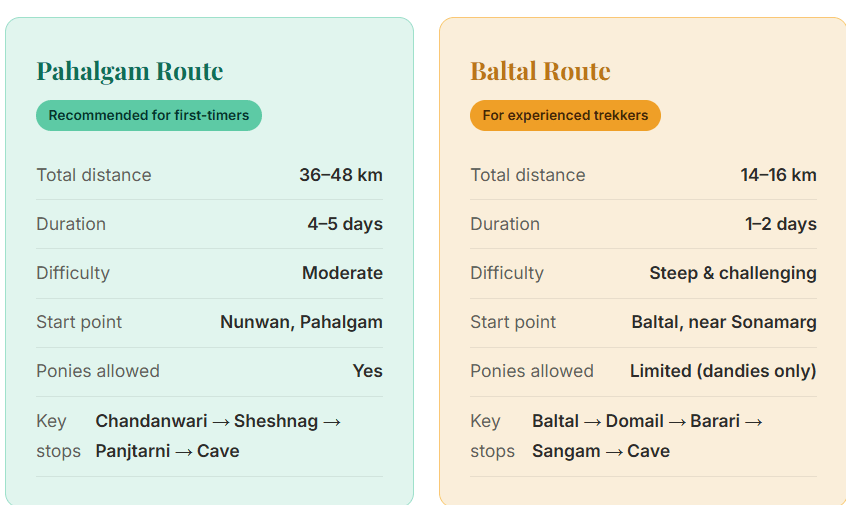
Pahalgam Route (Traditional): Starting from Nunwan base camp in Pahalgam (Anantnag district), this 48 km route follows a gradual ascent through the Lidder Valley, passing Chandanwari (a beautiful meadow), the turquoise glacial lake of Sheshnag, the high-altitude Mahagunus Pass (4,890m), and the meadow of Panjtarni before the final climb to the cave. Its gentler gradient makes it ideal for older pilgrims and first-timers. The journey is spread across 4–5 days with overnight halts at pre-set camps.
Baltal Route (Short & Steep): Beginning near Sonamarg in Ganderbal district, this 14 km route ascends sharply through gorges, passing Domail, Barari top, and Sangam before reaching the cave. Young, physically fit pilgrims complete it in a single gruelling day. Due to the extreme steepness and safety concerns, regular pony service is restricted on this route- pilgrims rely on dandies (carried chairs) or walk. Most pilgrims descend the same day.
📍 Route Tip
First-time pilgrims are strongly advised to choose the Pahalgam route for Amarnath Yatra. The Baltal route is shorter but significantly more demanding- the steep, rocky terrain at altitude is not suitable for those without trekking experience. To reach Baltal or Pahalgam with your group pilgrims, tempo traveller rental in Delhi is best way for a budgeted and personalised trip.
Helicopter Services: 2026 Update
🚁 Important 2026 Update: Helicopter Service Suspended
The J&K Government has issued Order No. 321–HOME of 2026 declaring a No Flying Zone over the Yatra corridor for 2026. Helicopter services from Baltal/Neelgrath and Pahalgam to Panjtarni have been officially suspended this year due to security, environmental, and crowd management concerns. Any website offering helicopter bookings for Amarnath Yatra 2026 is running a scam- do not pay or share your details.
The Yatra itself is fully operational- only aerial access has been removed. Both trekking routes remain active with full CRPF security, medical camps, and langar facilities. Pilgrims who previously relied on helicopters should plan to use pony or palki services, or trek on foot. For future reference: in regular years, helicopters operated from Neelgrath (Baltal) to Panjtarni (7–10 minute flight) and from Pahalgam to Panjtarni (15–20 minutes), dropping pilgrims 6 km from the cave. Costs in regular years ranged from ₹7,000 to ₹13,000 round trip.
Pony, Palki & Porter Charges
For pilgrims who cannot complete the full trek on foot — whether due to age, fitness level, or physical limitations — ponies, palkis (palanquins), and porters (pithus) are available at various points along both routes. Charges are regulated by the SASB and Jammu & Kashmir Labour Department.
| Service | Route | Approx. Charge | Notes |
|---|---|---|---|
| Pony | Pahalgam full route | ₹3,000–5,000 | Drops you 2 km before the cave |
| Pony | Per stage | ₹1,500–3,000 | SASB-regulated rates |
| Palki | Full route (Pahalgam) | ₹15,000–25,000 | 4 bearers carry you; book in advance |
| Palki | Per stage | ₹4,000–8,000 | Rates vary by segment |
| Dandie | Baltal route only | ₹3,000–6,000 | Carried chair; used where ponies restricted |
| Porter/Pithu | Both routes | ₹1,000–2,000/day | For carrying your bags (max 25 kg) |
💡 Booking Tip
Always hire ponies, palkis, and pithus through official SASB-registered counters at the base camps. This ensures government-regulated pricing and that service providers are properly registered and insured. Avoid roadside touts offering “cheaper” rates.
Stay & Accommodation Options
Accommodation on the Amarnath Yatra ranges from free community tents to comfortable prefabricated huts and hotels at base camps. Here is a breakdown of what to expect:
Free Tents (Langars)– ₹0
Basic shelter provided by NGOs, religious trusts. No frills- sleeping bags mandatory.
Prefab Huts (SASB)- ₹250–375/night
Available at Baltal, Nunwan, Sheshnag, Panjtarni. Limited- book via SASB or camp contractors.
Tourist Bungalows / Guesthouses– ₹800–2,500/night
At Pahalgam base camp and Sonamarg. Book well in advance through J&K Tourism.
Hotels in Pahalgam / Srinagar– ₹2,000–8,000/night
For pre/post-trek comfort. Wide range of options including houseboats on Dal Lake.
Key overnight halt points on the Pahalgam route are Chandanwari (Day 1), Sheshnag Lake (Day 2), Panjtarni (Day 3), and the cave (Day 4) before descent. On the Baltal route, most pilgrims stay only at the Baltal base camp and complete the trek as a same-day return.
🏕 Accommodation Tip
Accommodation at higher camps fills extremely fast during peak Yatra weeks (late July). Book huts through SASB or a registered tour operator at least 4–6 weeks before your trek date. Do not rely on walk-in availability at Sheshnag or Panjtarni.
Food & Drink Facilities En Route
One of the most heartening aspects of the Amarnath Yatra is the extraordinary tradition of langar seva– free community kitchens run by religious organisations, NGOs, and charitable trusts all along both routes. You will never go hungry on the Yatra trail.
Langars are set up at virtually every major halt point and serve hot vegetarian meals- mostly dal, rice, khichdi, chapati, tea, and sometimes halwa- completely free of charge. The langars are manned by volunteers and operate round the clock during the Yatra season. It is one of the most profound expressions of collective devotion you will witness on the journey.
Tea stalls and small eateries are available at Chandanwari, Sheshnag, and Panjtarni. They serve chai, Maggi noodles, packaged biscuits, glucose biscuits, and limited hot meals at reasonable prices. Prices are slightly higher than plains due to the logistics of supply, which is entirely understandable.
Drinking water is available at water points maintained by SASB and the Army along both routes. However, always carry a personal 1-litre water bottle and a water purification tablet or UV pen — glacial streams are beautiful but can carry pathogens at lower sections of the route. Dehydration at altitude accelerates altitude sickness, so aim to drink at least 3–4 litres of water per day.
⚠ Health Warning
Avoid alcohol, tobacco, and non-vegetarian food for at least 2–3 days before and during the Yatra. These strain your system at altitude. Carry oral rehydration salts (ORS), glucose powder, and dry fruits to keep energy levels stable between meals.
Essential Tips for a Safe Yatra
- Always carry your RFID card and permit– These are checked at multiple points on both routes and at the cave entrance. Losing them can result in being turned back.
- Travel in groups– Solo trekking is technically permitted but strongly discouraged, especially on the Baltal route. Groups are safer in emergencies and help maintain morale. If you are travelling in a big group of more than 25 persons, consider booking Mini Bus on Rent in Delhi– suitable for long journeys as Amarnath Yatra.
- Start early each day– Weather in the Himalayas deteriorates rapidly in the afternoon. Begin trekking by 5–6 AM to complete major sections before noon.
- Do not rush– Altitude sickness is caused by ascending too quickly. The golden rule: climb high, sleep low. Take rest days if you feel breathless, have a headache, or feel nauseous.
- Wear layered clothing– Temperatures at the cave can drop below 0°C even in July. Layers allow you to adjust to rapid temperature changes throughout the day.
- Carry a mobile power bank and spare batteries– BSNL offers the best network coverage, but connectivity is patchy above Chandanwari. Power banks are essential for staying in contact and navigating in emergencies.
- Know the symptoms of altitude sickness (AMS)– Headache, dizziness, nausea, and loss of appetite are warning signs. If symptoms worsen, descend immediately and seek medical help. SASB maintains medical camps at all major halts.
- Respect the environment-Carry all your waste back with you. The Himalayas are sacred ground. Do not litter, pick flowers, or disturb wildlife.
Complete Packing Guide for Amarnath Yatra
Your backpack is your lifeline on the Yatra. Keep it light- ideally under 8–10 kg for trekkers. If you are hiring a porter or pony for luggage, you can carry slightly more in a secondary bag. Here is a category-wise packing checklist:
📋 Documents
- Yatra permit (3 copies)
- RFID card
- Aadhaar card (original + copies)
- Compulsory Health Certificate
- Travel insurance document
- Emergency contact card
🧥 Clothing
- Thermal innerwear (2 sets)
- Fleece or woollen mid-layer
- Waterproof / windproof jacket
- Trek pants × 2
- Woollen socks × 4 pairs
- Gloves and woollen cap
- Waterproof trekking boots
- Rain poncho or gaiters
- Warm muffler / neck gaiter
💊 Medical Kit
- Diamox (altitude sickness tablets)
- Paracetamol / Ibuprofen
- Antacids and ORS packets
- Glucose powder
- Bandages, antiseptic cream
- Personal prescription medicines
- Moleskin for blisters
- Lip balm and sunscreen SPF 50+
🎒 Gear
- 45–55 L trekking backpack
- Rain cover for backpack
- Trekking poles (foldable)
- Sleeping bag (rated to -5°C)
- Headlamp + spare batteries
- Mobile power bank (20,000 mAh)
- Waterproof bag for documents
- Whistle and emergency torch
🍫 Nutrition
- Dry fruits and trail mix
- Energy bars (8–10 per day)
- Dark chocolate
- Electrolyte sachets
- Instant oats / porridge packets
- 1-litre water bottle + purifier
🛁 Toiletries
- Small biodegradable soap
- Toothbrush and paste
- Wet wipes (heavy duty)
- Hand sanitiser
- Sunglasses (UV400)
- Toilet paper / tissues
- Small quick-dry towel
💡 Packing Rule
Lay everything out, then remove one-third of it. On a mountain at altitude, every extra kilogram costs you energy you cannot afford to waste. Prioritise warmth and safety items over comfort. Your heaviest single item should be your sleeping bag- everything else should be as lightweight as possible.
Nearby Places to Explore
The Kashmir Valley is one of the most beautiful places on earth- pair your Yatra with a few days of sightseeing in Kashmir before or after the pilgrimage for a complete experience.
Sonamarg
15 km from Baltal base. Stunning glaciers, meadows, and the Zoji La pass viewpoint.
Dal Lake, Srinagar
Iconic shikara rides, floating markets, and the famous houseboats of Kashmir.
Pahalgam Valley
Alpine meadows, Baisaran (Mini Switzerland), Aru Valley, and Betaab Valley.
Shankaracharya Temple
Ancient Shiva temple atop a hill in Srinagar with panoramic valley views.
Mughal Gardens
Shalimar Bagh, Nishat Bagh, and Chashme Shahi- terraced Mughal masterpieces.
Martand Sun Temple
8th-century Kashmiri Hindu ruins near Anantnag- an architectural marvel.
Gulmarg
2.5 hours from Srinagar. Asia’s highest gondola, ski resort, and meadow treks.
Vaishno Devi
Another sacred pilgrimage near Katra, Jammu- often combined as a single trip. Find Here: Complete Trip Plan, cost for Vaishno Devi Yatra from Delhi in Tempo Traveller
Additional Things No One Tells You
Mobile network: BSNL works best across the Amarnath Yatra corridor. Airtel and Jio have limited or no coverage beyond Chandanwari on the Pahalgam route. Get a BSNL SIM before leaving Srinagar or Jammu.
ATMs: There are no ATMs on the trail. Carry sufficient cash- ideally ₹5,000–8,000 in small denominations before leaving the base camp. Card payments are not accepted anywhere on the route.
Timing of darshan: The cave receives thousands of pilgrims daily. The queue for darshan can be 2–8 hours long during peak weeks. If you arrive at Panjtarni by 6 AM, you stand a chance of completing darshan by mid-morning and beginning descent in good weather.
Photography: No professional cameras or drones are permitted inside the cave or near security installations. A smartphone is all you need and will be allowed.
Travel insurance: This is non-negotiable. Ensure your policy covers high-altitude trekking (above 3,500 metres), emergency evacuation, and medical hospitalisation. Many standard travel insurance policies exclude altitude trekking- read the fine print.
Har Har Mahadev 🙏
May your Yatra be safe, your steps be blessed, and your darshan be divine. Register early at jksasb.nic.in and carry every layer you own.
