

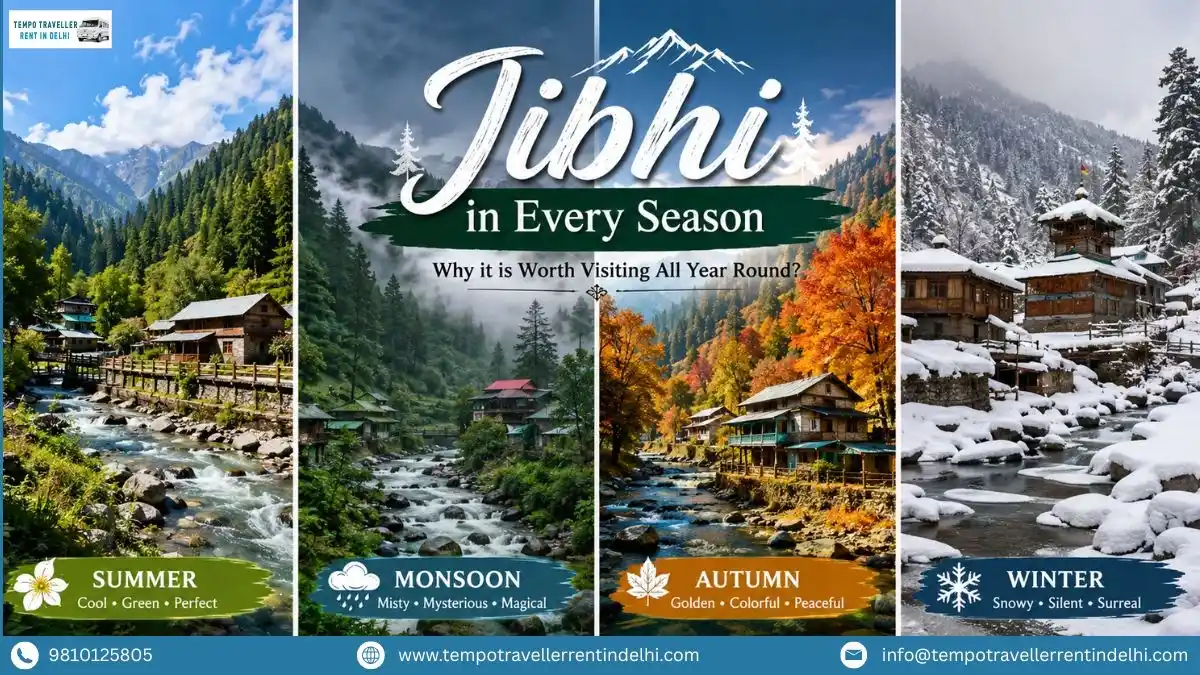
Most Himachal destinations have an obvious “best season.” Manali is for summers. Kasol is for spring. Shimla is for Christmas. But Jibhi- a tiny village tucked in the Tirthan Valley of the Banjar region, defies that logic entirely. This guide explains exactly why Jibhi in every season looks magical.
Jibhi sits at an altitude of approximately 2,400 metres above sea level, nestled along the banks of the Jibhi Nala stream in the Kullu district of Himachal Pradesh. It is about 510 km from Delhi- a long but utterly beautiful drive through the Himalayan foothills, pine forests, and apple orchards. The village is small enough to explore entirely on foot, yet rich enough in experiences that travellers often extend their stays by days.
Unlike more commercialised hill stations, Jibhi has retained its authentic Himachali character. The wooden houses with slate roofs, the prayer flags fluttering over wooden temples, the sound of the stream through the forest- Jibhi is the kind of place that slows you down in the best possible way.
“Jibhi is what Kasol was ten years ago- before the crowds found it. Go now, while it still belongs to the mountains.”
Why Jibhi is Different from Other Himachal Hill Stations?
Before we break down the seasons, it is worth understanding what makes Jibhi unique in every season.
- It is inside the Great Himalayan National Park buffer zone– Meaning the forests around it are dense, protected, and teeming with wildlife including snow leopards, brown bears, and Himalayan birds.
- The Tirthan River– One of the cleanest rivers in Himachal Pradesh– flows nearby and is home to brown trout, making it a paradise for fly-fishing enthusiasts.
- Traditional Himachali architecture– Jibhi’s temples, guesthouses, and homes are built in the Kath-Kuni style (stone and wood layers), a dying art form.
- Minimal commercialisation– There are no malls, no ATMs (carry cash), no nightlife spots. Just the mountains, the stream, and the stars.
- Proximity to treks– Trails to Jalori Pass, Serolsar Lake, Raghupur Fort, and Bashleo Pass all start within a short distance of Jibhi.
Jibhi in Summer (April to June)- Cool, Green, and Perfect
When the plains of Delhi and Rajasthan are scorching at 42–45°C, Jibhi maintains a pleasant 15–25°C. This is peak season, and for good reason- the village is at its most accessible, the roads are clear, and the valley is alive with wildflowers, apple blossoms, and the fresh green of pine and oak forests.
Summer is the ideal time for trekking. The trail to Jalori Pass (3,120 m) is fully open, and from the pass, you can walk to the serene Serolsar Lake– a sacred high-altitude lake surrounded by deodar trees. The trail to Raghupur Fort rewards hikers with one of the most panoramic views of the Kullu-Tirthan ranges.
Summer Highlights:
- Trek to Serolsar Lake via Jalori Pass (15 km round trip)
- Explore Raghupur Fort- ruins of a fort with sweeping Himalayan views
- Fly fishing in the Tirthan River (season permits required)
- Village walk through Jibhi, Shoja, and Ghiyagi
- Campfire evenings at riverside campsites
Accommodation fills up fast in summer. Book your stay at least 3–4 weeks in advance. Homestays and wooden cottages are the preferred choice over hotels — they are more authentic and more comfortable for families.
Temperature: 15–25°C daytime, 8–12°C at night | Crowd Level: High (peak season) | Road Condition: Excellent
Jibhi in Monsoon (July to September) 🌧️- Misty, Mysterious, and Dramatically Beautiful
Here is the counterintuitive truth: Jibhi in the monsoon is absolutely stunning. The hills turn every shade of green imaginable. Waterfalls appear on every cliff face. The Jibhi Nala swells with clear, cold water rushing over smooth boulders. Low clouds drift through the pine forests like slow ghosts. It is atmospheric in a way that dry seasons simply cannot replicate.
Yes, there are risks. Landslides on mountain roads are a real concern, especially on the Aut–Banjar road. Trekking to Jalori Pass may be inadvisable on heavy-rain days. But for those who plan carefully and travel in a reliable vehicle, the monsoon Jibhi experience is one of the most rewarding in all of Himachal.
Monsoon Highlights:
- Waterfall chasing – dozens of seasonal falls appear throughout the valley
- Photography – mist-draped forests and streams are extraordinary
- Quiet village life – far fewer tourists, more authentic interactions
- Birdwatching – migratory species arrive during this period
- Stream -side reading and relaxation – riverside homestays are magical during rain
Avoid solo travel in monsoon. Travel in a group with a sturdy vehicle and an experienced driver. This is another reason why booking a Tempo Traveller from Delhi for a monsoon Jibhi trip is a wise decision- our drivers are familiar with mountain road conditions and know how to navigate safely.
Temperature: 12–20°C | Crowd Level: Low (best for peace) | Road Condition: Variable — check before travel
Jibhi in Autumn (October to November) 🍂-The Golden Secret Season
If you ask seasoned Jibhi travellers for their favourite season, most will say autumn without hesitation. And once you see it, you will understand. In October and November, the forests around Jibhi transform into a painter’s palette- oak, maple, and horse-chestnut trees turn gold, amber, and deep crimson. The sky is crystal blue, the air is crisp, and the crowds of summer are gone.
Autumn also brings the apple harvest. The orchards near Jibhi, Shoja, and Banjar are heavy with fruit, and local families invite travellers to pick and eat. It is a deeply wholesome experience- wandering through an apple orchard at 2,400 metres with the Himalayas framed behind you.
Autumn Highlights:
- Golden forest walks – the most photogenic season in Jibhi
- Apple orchard visits – participate in the harvest with local families
- Jalori Pass trek – clear skies, zero crowds, and peak panoramas
- Cultural immersion – local festivals and fairs in October
- Stargazing – the autumn skies over Jibhi are world-class
October and November see Jibhi at its most atmospheric. Roads are clear, weather is stable, and the village feels like it belongs to you alone. This is arguably the best month to visit Jibhi and our Delhi to Jibhi Tempo Traveller package is popular for autumn getaways with friends and families.
Temperature: 5–18°C | Crowd Level: Medium-Low | Road Condition: Good
Jibhi in Winter (December to March) – Snow, Silence, and Surreal Beauty
Jibhi in winter is not for the faint-hearted- but for those who make it, the reward is extraordinary. From late December through February, the village is blanketed in snow. The pine trees carry snow on their branches like nature’s own decoration. The stream slows, the air tastes like ice, and the silence is total. This is a completely different Jibhi- slower, quieter, and almost transcendental.
Jalori Pass is typically closed in deep winter due to snowfall. However, the valley itself remains accessible, and the village walks, temple visits, and forest treks near Jibhi remain beautiful. Sitting by a wood fire in a Himachali homestay with a cup of chai while snow falls outside is one of travel’s great simple pleasures.
Winter Highlights:
- Snow walks around Jibhi village and surrounding forests
- Jibhi Waterfall – partially frozen and absolutely breathtaking
- Quiet forest trails – pristine snow, no crowds
- Warm homestay experience – wood fires, local food, Himachali hospitality
- Photography – snow-covered Kath-Kuni temples and wooden houses
Important note: The road from Aut to Jibhi can close temporarily after heavy snowfall. Always check road conditions before departing. A 4WD vehicle or a Tempo Traveller with experienced mountain-driving knowledge is strongly recommended for winter trips.
Temperature: -5°C to 10°C | Crowd Level: Very Low | Road Condition: Snow-affected, check daily
How to Reach Jibhi from Delhi
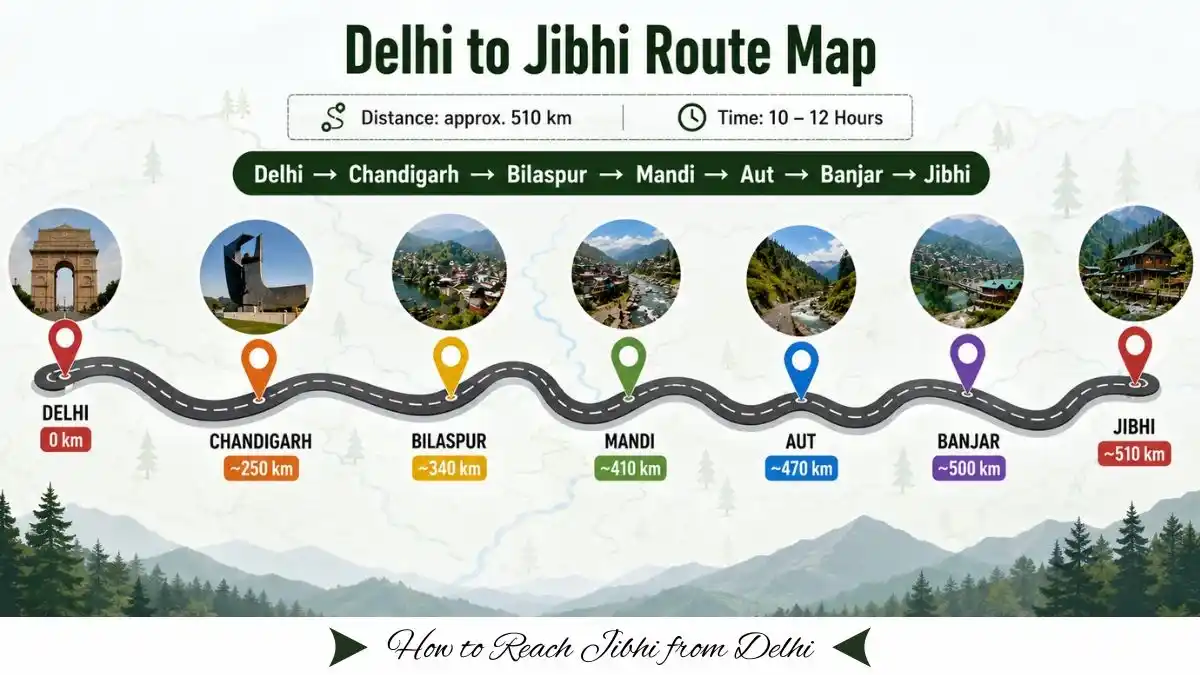
Jibhi is approximately 510 km from Delhi, and the drive takes 10–12 hours depending on your route and road conditions. The standard route is:
Delhi → Chandigarh → Bilaspur → Mandi → Aut → Banjar → Jibhi
The drive from Delhi to Jibhi is best done overnight or very early in the morning to cover the highway stretch (Delhi to Chandigarh) before peak traffic. You can depart from Delhi by 10–11 PM for a comfortable 10–11 AM arrival in Jibhi.
For a group trip of 6–15 people, Tempo Traveller hire in Delhi is the most practical option. Everyone travels together, the luggage fits comfortably, and the driver can manage the mountain sections around Aut–Banjar–Jibhi safely.
- By road (Tempo Traveller/Car): Delhi → Jibhi, approximately 510 km, 10–12 hours
- By train + taxi: Delhi to Chandigarh or Pathankot by train, then taxi to Jibhi (4–5 hours). Not recommended for large groups with luggage.
- By bus: HRTC buses from Delhi ISBT (Kashmere Gate) to Banjar, then local taxi to Jibhi. Budget option but very long journey.
🏔️ Planning a Jibhi trip from Delhi? Book a Tempo Traveller for your group and travel safely and comfortably through the mountains. Available in 9, 12, and 17-seater configurations.
Where to Stay in Jibhi
Jibhi has a fantastic range of accommodations- mostly homestays and boutique wooden cottages run by local Himachali families. Here are the types of stays available:
- Traditional Homestays: Stay with a Himachali family in a wooden home, eat local food, and experience real village life. Best for culture-seekers.
- Riverside Cottages: Wooden cottages right on the banks of Jibhi Nala- the sound of the stream is a permanent backdrop. Most popular option.
- Forest Campsites: A handful of eco-camps operate in the pine forests above Jibhi, best suited for summer and autumn.
- Treehouses: A few boutique properties in and around Jibhi offer treehouse accommodations- popular with couples and solo travellers.
Budget per night ranges from ₹800–1,200 for basic homestays to ₹3,000–6,000 for premium cottages. Always book ahead for summer and October.
Things to Do in and Around Jibhi
- Jalori Pass Trek – The most popular trek from Jibhi, leading to panoramic Himalayan views
- Serolsar Lake – A sacred lake beyond Jalori Pass, surrounded by dense deodar forest
- Raghupur Fort – Ancient ruins atop a ridge with 360° views
- Jibhi Waterfall – A short 20-minute walk from the village centre
- Tirthan River – Swimming, trout fishing, and riverside picnics
- Shoja Village – A short drive from Jibhi, even quieter and more remote
- Chhoie Waterfall – A lesser-known fall accessible via a forest trail near Ghiyagi
- Great Himalayan National Park – Day entry permits available for wildlife and birdwatching
Frequently Asked Questions about Jibhi
Is Jibhi a good destination for families with kids?
Yes, Jibhi is excellent for families. The village is safe, walkable, and rich with nature experiences children love- waterfalls, forest walks, streams, and local culture. Avoid deep winter months (January–February) with very young children.
Is Jibhi better than Kasol?
They are different experiences. Kasol has a party/backpacker culture. Jibhi is quieter, more family-friendly, and more nature-focused. For families, couples, and those seeking peace, Jibhi is the better choice.
How many days are enough for Jibhi?
3 to 4 days is ideal- one day for the Jalori Pass–Serolsar Lake trek, one day for Raghupur Fort and the waterfall, and one day to simply relax by the stream. Ambitious travellers add Shoja and Tirthan Valley on extra days.
Is Jibhi accessible in winter?
The village of Jibhi is accessible most of winter, but Jalori Pass (the road beyond Jibhi) closes in heavy snowfall. A 4WD or a Tempo Traveller with an experienced driver is recommended. Always check road conditions from Himachal Road Transport Corporation before departing.
How to go from Delhi to Jibhi by Tempo Traveller?
The drive is approximately 510 km via Chandigarh–Mandi–Aut. Most groups leave Delhi by 10 PM to arrive in Jibhi the next morning. Book Maharaja Tempo Traveller on rent for the most comfortable group travel experience.
Why Jibhi Belongs on Your Travel List Right Now?
Jibhi is at a rare inflection point. It has been discovered enough that infrastructure and homestay quality are excellent, but not so discovered that it has been commercialised into anonymity. The Jibhi of today is the Manali of 1995- genuine, gorgeous, and generous with its beauty.
Whether you go in summer for the wildflower treks, in monsoon for the misty waterfalls, in autumn for the golden forests, or in winter for the snow silence, Jibhi will always give you something profound. It is not just a destination- it is a feeling. And once you have felt it, you will keep coming back, season after season.
