


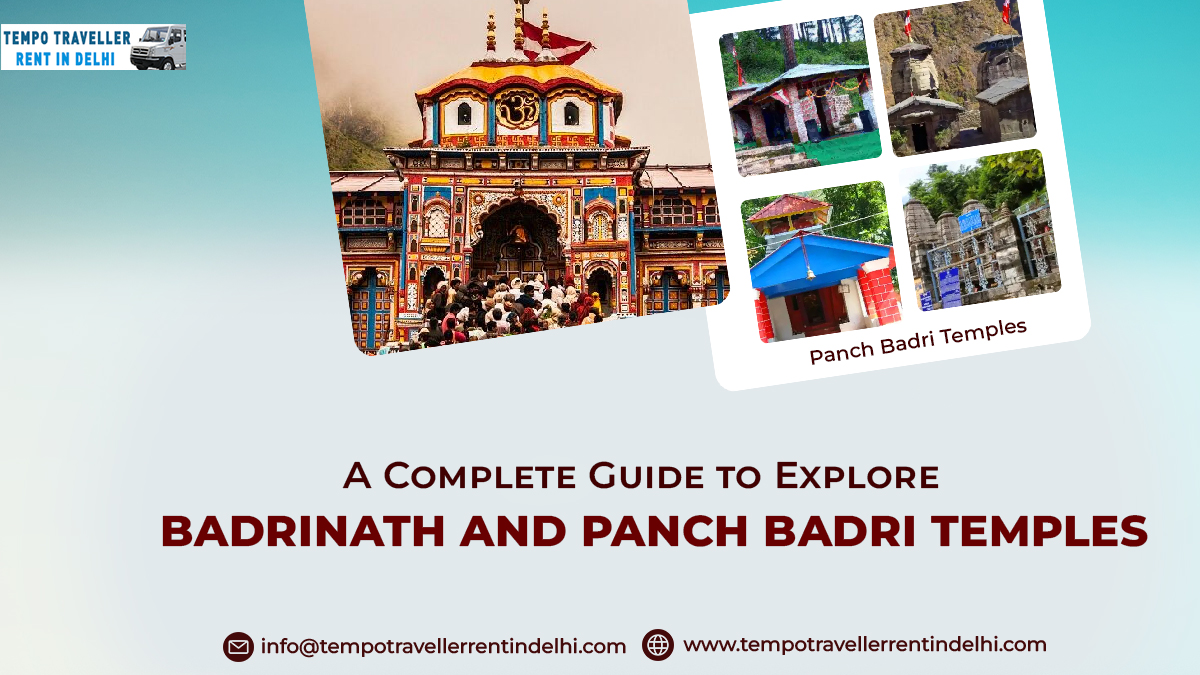
Where the Himalayas meet the divine- five sacred abodes of Lord Vishnu
Altitude: 3,133 m · 5 Sacred Temples · Open May–November · Char Dham Circuit
Nestled at 3,133 metres in the Garhwal Himalayas, Badrinath is not merely a destination- it is a calling for Moksha. For over a thousand years, pilgrims have crossed raging rivers and ancient mountain passes to bow before Lord Vishnu’s most sacred adobe. The Panch Badri circuit, of which Badrinath is the crown jewel, connects five Vishnu temples scattered across Uttarakhand’s breathtaking landscape. This is your complete guide to experiencing them all– Badrinath and Panch Badri Temples.
01) Badrinath Dham: The Crown of the Himalayas
Standing sentinel against the snowy peaks of Neelkanth mountain at 6,596 metres, the Badrinath Temple is one of the four sacred Char Dhams of Hinduism and the most important Vaishnava pilgrimage site in North India. The presiding deity is Badrinarayan- Lord Vishnu depicted in a black stone form seated in padmasana (lotus posture), a posture so rare that this temple is among the very few in India where the deity is shown in a meditative stance rather than a standing or reclining form.
The temple’s origins are attributed to the 8th-century philosopher-saint Adi Shankaracharya, who is said to have retrieved the idol of Badrinarayan from the Alaknanda River and reinstalled it in its present location. The current structure, with its striking multi-coloured facade, ornate shikhara tower, and golden roof dome, reflects centuries of renovation by the Garhwal royal family and the Archaeological Survey of India.
The temple complex sits between the Nar and Narayan mountain ranges on the banks of the Alaknanda River. Adjacent to the main shrine, the hot spring of Tapt Kund, where water maintains a constant 45°C despite sub-zero air temperatures, is considered sacred. Pilgrims traditionally bathe here before entering the temple. Nearby, the Brahma Kapal ghat is the sole sanctioned place on the Alaknanda banks where Hindus perform pitru tarpan (ancestral rites).
“The deity is believed to meditate under the Badri tree (Indian jujube), hence the name Badrinath- Lord of the Badri forest.”
QUICK FACTS
| ALTITUDE 3,133 m | OPENING HOURS 4:30 AM – 9 PM | ENTRY FEE Free | DISTRICT Chamoli, Uttarakhand |
Must Read: How much time required for Chardham Yatra from Delhi?
02) The Panch Badri: Five Abodes of Vishnu
The Panch Badri (Five Badris) are five sacred shrines dedicated to Lord Vishnu spread across the Chamoli district of Uttarakhand. Hindu scripture holds that Vishnu resided in the entire Badrinath valley in five different forms. Together, these five temples form a pilgrimage circuit that is both spiritually profound and scenically extraordinary- threading through alpine meadows, dense cedar forests, deep gorges, and ancient villages that have barely changed in centuries.
| # | Temple | Location | Significance |
| 01 | Vishal Badri | Badrinath, 3,133 m | The primary shrine. Vishnu in padmasana (meditative lotus posture). The fulcrum of all Char Dham yatras. |
| 02 | Yogadhyan Badri | Pandukeshwar, 1,920 m | Vishnu in a deep yogic posture. King Pandu of the Mahabharata performed penance here. Ancient shaligram stone idol. |
| 03 | Bhavishya Badri | Subain, 2,744 m | Most remote- 3 km trek from Tapovan. Scriptures say this will become the primary Vishnu seat when Badrinath becomes inaccessible. |
| 04 | Vridha Badri | Animath, 1,380 m | Vishnu appeared here as an old man (vridha) to sage Narada. Open year-round. One of the oldest stone idols in the circuit. |
| 05 | Adi Badri | Karnaprayag, 1,000 m | A cluster of 14 Gupta-era temples (4th–6th century CE). Black stone Vishnu idol in standing posture. Most photogenic of the five. |
How to Reach Badrinath?
Badrinath is connected to the rest of India by road, with the nearest railhead at Rishikesh (295 km) and the nearest airport at Jolly Grant in Dehradun (317 km). The journey through Devprayag, Rudraprayag, Karnaprayag, and Joshimath is one of the most beautiful drives in India- the Alaknanda River thunders alongside the road most of the way.
| From | Mode | Distance | Duration |
| Delhi | Bus / Taxi to Rishikesh, then onwards | ~520 km | 14–16 hrs |
| Dehradun (Airport) | Taxi or Bus via Rishikesh | 317 km | 9–11 hrs |
| Rishikesh | GMOU Bus or Shared Taxi | 295 km | 8–10 hrs |
| Haridwar | Bus or Private Taxi | 315 km | 9–11 hrs |
| Joshimath | Bus or Taxi (last major town) | 46 km | 1.5–2 hrs |
| Govindghat | Helicopter Charter (seasonal) | — | ~15 mins |
GMOU buses run daily from Rishikesh and Haridwar during the yatra season (May–November). Private taxis offer more flexibility. Helicopter services from Govindghat helipad to Badrinath are available on booking through private operators.
Best Time to Visit Badrinath and Panch Badri Temples
The Badrinath temple opens annually on the auspicious occasion of Akshaya Tritiya (April–May) and closes on the day of Diwali (October–November). The exact dates are announced by the temple committee based on the Hindu calendar. Outside this window, the temple is submerged under several feet of snow.
| ✦ Ideal — May to June Clear skies, pleasant temperatures (8–20°C). Best mountain views. Manageable crowds early in the season. | ◦ Good- Sep to Nov Post-monsoon clarity. Stunning autumn colours. October is particularly beautiful before temple closure. | ✗ Avoid- July to Aug Monsoon season. Serious risk of landslides, road blockages, and flash floods. Travel not recommended. |
The temple’s closing ceremony is an event in itself. On the night of Diwali, the priest ceremonially locks the doors and a lamp (Akhand Jyoti) is left burning inside, it is found still burning when the doors reopen six months later, a phenomenon devotees consider a divine miracle.
Travel in Comfort: Book a Tempo Traveller for This Yatra
The Badrinath and Panch Badri circuit covers an enormous amount of mountain terrain- the full loop from Rishikesh, covering all five temples and returning, spans roughly 700–800 km of Himalayan highway. While shared buses work for budget solo pilgrims, families and groups of six or more will find a Tempo Traveller to be the single most practical, comfortable, and economical way to complete this sacred journey. It puts your itinerary entirely in your own hands- critical when you’re navigating temple opening times, weather windows, and the unpredictable rhythms of Himalayan travel.
The Badrinath route demands a vehicle that can handle altitude, steep gradients, narrow mountain roads, and sudden weather changes. Tempo Travellers on this route are purpose-built for hill travel, their higher ground clearance, powerful engines, and experienced drivers make them far more suitable than ordinary city cabs. You stop at the Prayag confluences- Devprayag, Rudraprayag, Karnaprayag, without the pressure of a bus schedule. You reach Tapt Kund before sunrise for the early bath. You make an unplanned halt at a dhaba in Pipalkoti when the mountains are particularly beautiful. These small freedoms, multiplied over seven days, transform a pilgrimage into a genuine Himalayan journey. To plan Badrinath Dham Yatra from Delhi, go for Tempo Traveller hire in Delhi for a comfortable journey throughout.
| TEMPO TRAVELLER- KEY FACTS FOR BADRINATH CIRCUIT Capacity: 9, 12, 14, 16, 18, 20, 25 seater options- ideal for families and pilgrim groups Approximate cost: Rs. 20,000–35,000 for a 7–9 day Haridwar/Rishikesh round circuit (driver and fuel included) Flexible itinerary: stop at Devprayag, Rudraprayag, and Karnaprayag confluences along the way Covers all five Panch Badri temples without needing separate local transport at each stop Luggage-friendly boot space– Essential for warm clothing, sleeping bags, and trekking gear Experienced drivers on the Badrinath highway know weather windows, road closure updates, and alternate routes AC variants available; even non-AC is comfortable as temperatures at altitude stay naturally cool. If you book Maharaja Tempo Traveller on Rent, it will offer more comfort compared to standard ones. Book through verified operators in Haridwar, Rishikesh, or Dehradun; confirm tourist permit, fitness certificate, and hill-driving experience before finalising |
For the Panch Badri circuit, a Tempo Traveller hired from Delhi, Rishikesh or Haridwar is also the most logical way to visit all five temples efficiently. With Joshimath as a base, you can cover Yogadhyan Badri (Pandukeshwar), Vridha Badri (Animath), and Bhavishya Badri (Tapovan) as day trips, then drive to Badrinath for the main darshan, and descend via Adi Badri (Karnaprayag) on the way home- a perfect circular route that wastes no distance and misses nothing.
How to Plan Your Panch Badri Tour in Uttarakhand?
The most efficient way to cover all five Badris is on a dedicated 5–7 day circuit originating from Rishikesh or Haridwar. The temples can be visited in the order Adi Badri → Vridha Badri → Yogadhyan Badri → Vishal Badri (Badrinath) → Bhavishya Badri, following a logical geographic route up the valley. Joshimath at 1,890 metres is the ideal base for the circuit- it is the last major town before Badrinath and also the winter seat of the Badrinath deity.
Practical Tips for the Yatra
- Register for the Char Dham Yatra biometric registration- mandatory; available online at registrationandtouristcare.uk.gov.in or at counters in Haridwar and Rishikesh
- Acclimatise at Joshimath (1,890 m) for at least one night before ascending to Badrinath (3,133 m)- altitude sickness is a genuine risk
- Carry warm clothing regardless of the season- temperatures at Badrinath drop to 1–5°C even in summer evenings
- The Tapt Kund hot spring bath before the temple visit is traditional and practically reviving in the cold air- go early before the crowds
- For Bhavishya Badri, hire a local guide from Tapovan- the 3 km trail is not always clearly marked
- Book GMVN (Garhwal Mandal Vikas Nigam) guesthouses in advance for cleaner, more reliable accommodation in Badrinath town
- Carry sufficient cash- ATMs in Badrinath are unreliable; the last dependable ATM is in Joshimath
- Non-Hindus are welcome at all five temples; respectful dress covering shoulders and legs is required
Beyond the Temples: What Else to See
The Badrinath region is extraordinarily rich beyond its religious significance. The Valley of Flowers National Park, a UNESCO World Heritage Site, lies 15 km from Govindghat- a seasonal bloom of 500 alpine flower species set in a hanging valley at 3,600 metres, accessible June through October. Hemkund Sahib, the highest Sikh Gurudwara in the world at 4,329 metres beside a glacial lake, is on the same route and combines magnificently with a Badrinath pilgrimage.
Mana village, 3 km from Badrinath, holds the distinction of being the last inhabited village before the Indo-Tibet border. The mythological landmarks here are extraordinary- Vyas Gufa (the cave where sage Vyasa compiled the Mahabharata), Bhim Pul (a natural rock bridge over the roaring Saraswati River), and views of the Vasudhara waterfall against a backdrop of glaciers. For the adventure-inclined, Satopanth Lake at 4,600 metres offers a spectacular 2-day trek from Badrinath that few undertake but all who do remember forever.
Suggested Read: How to plan a trip to Kedarnath from Delhi?
Final Thoughts
The Badrinath and Panch Badri Temples circuit is a journey that operates on multiple registers simultaneously. As a religious pilgrimage, it connects you to one of Hinduism’s oldest and most geographically expansive sacred traditions. As a natural experience, it takes you through some of the most dramatic mountain terrain on the planet. And as a human journey, the physical commitment required- the long drives, the altitude, the cold has a way of stripping away the ordinary and leaving you very present.
Whether you arrive as a devotee seeking blessings, a traveller drawn by the mountains, or simply someone curious about how a civilisation has organised its spiritual life across an entire Himalayan range, Badrinath and the Panch Badri circuit will not disappoint. A Tempo Traveller, a warm jacket, and a flexible schedule- these are all you need. The Himalayas, and Lord Vishnu’s five abodes within them, will take care of the rest.