

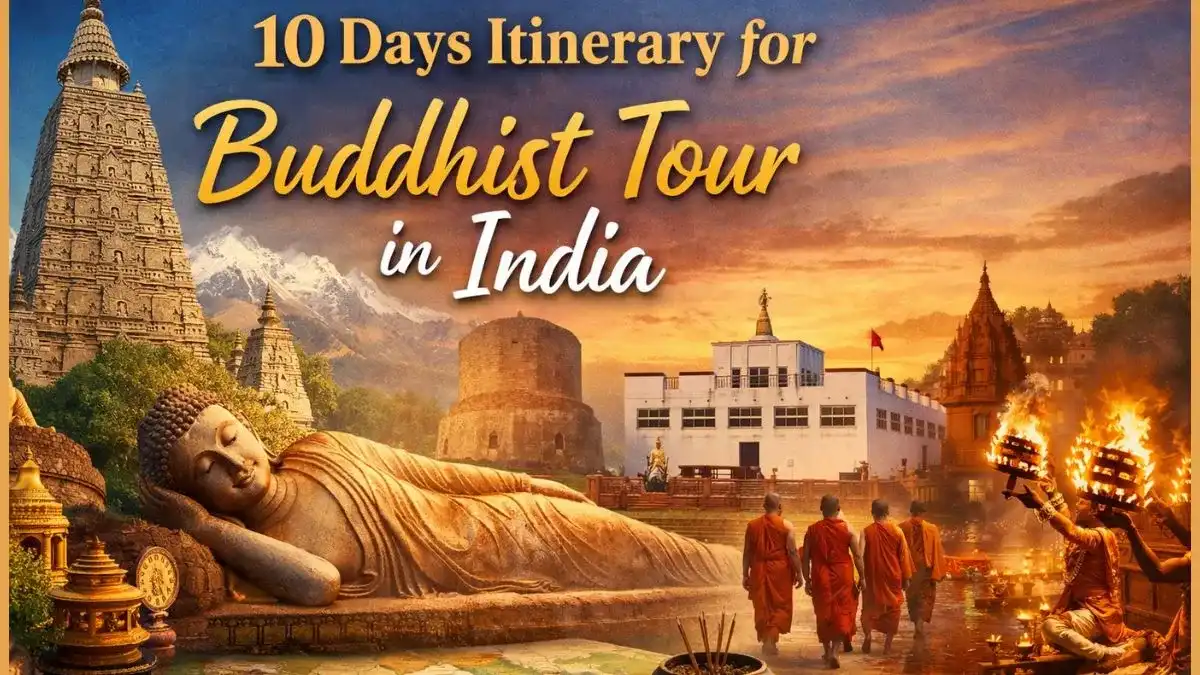
The Complete Itinerary- Following the Sacred Footsteps of the Buddha
India is the cradle of Buddhism- the land where Prince Siddhartha Gautama was born, attained enlightenment, delivered his first sermon, and finally passed into Mahaparinirvana over 2,500 years ago. For Buddhist pilgrims and spiritual travellers from Thailand, Japan, South Korea, Sri Lanka, China, Vietnam, Myanmar, the United States, and across Europe, a Buddhist tour in India is considered one of the most meaningful journeys a person can undertake in their lifetime.
The Buddhist Circuit India covers the Eight Great Sacred Sites- the Attha-mahathanani- spread across the states of Bihar, Uttar Pradesh, and across the border into Nepal. This 10-day Buddhist tour itinerary is designed to cover all major sites efficiently, with enough time at each for meditation, prayer, and genuine absorption of the sacred atmosphere. Whether you are a devout Buddhist pilgrim, a history enthusiast, or a spiritual seeker, this Buddhist heritage tour of India will transform the way you see the world.
Why India is the World’s Most Important Buddhist Destination?
With over 535 million Buddhists worldwide, India holds a unique and irreplaceable position as the birthplace and heartland of the Buddhist faith. Unlike any other country, India contains the actual physical locations where the historical Buddha lived, walked, and taught- making a Buddhist tour of India a profoundly different experience from visiting Buddhist temples in Thailand, Japan, or elsewhere.
The four most sacred Buddhist sites in the world- known as the Four Holy Buddhist Pilgrimage Sites- are all within reach of a single journey through northern India and southern Nepal. Combined with the four additional miracle sites, the complete Eight Great Places Buddhist circuit is entirely accessible in 10 days, making India the ultimate destination for Buddhist pilgrimage tourism.
- Bodh Gaya: Where Siddhartha Gautama attained enlightenment and became the Buddha
- Sarnath: Where the Buddha delivered his first sermon and founded the Sangha
- Kushinagar: Where the Buddha attained Mahaparinirvana and passed from this world
- Lumbini (Nepal): The birthplace of Prince Siddhartha – a UNESCO World Heritage Site
- Rajgir, Nalanda, Vaishali, Sravasti & Sankissa: The four additional sacred miracle sites
10-Day Buddhist Circuit India- Itinerary at a Glance
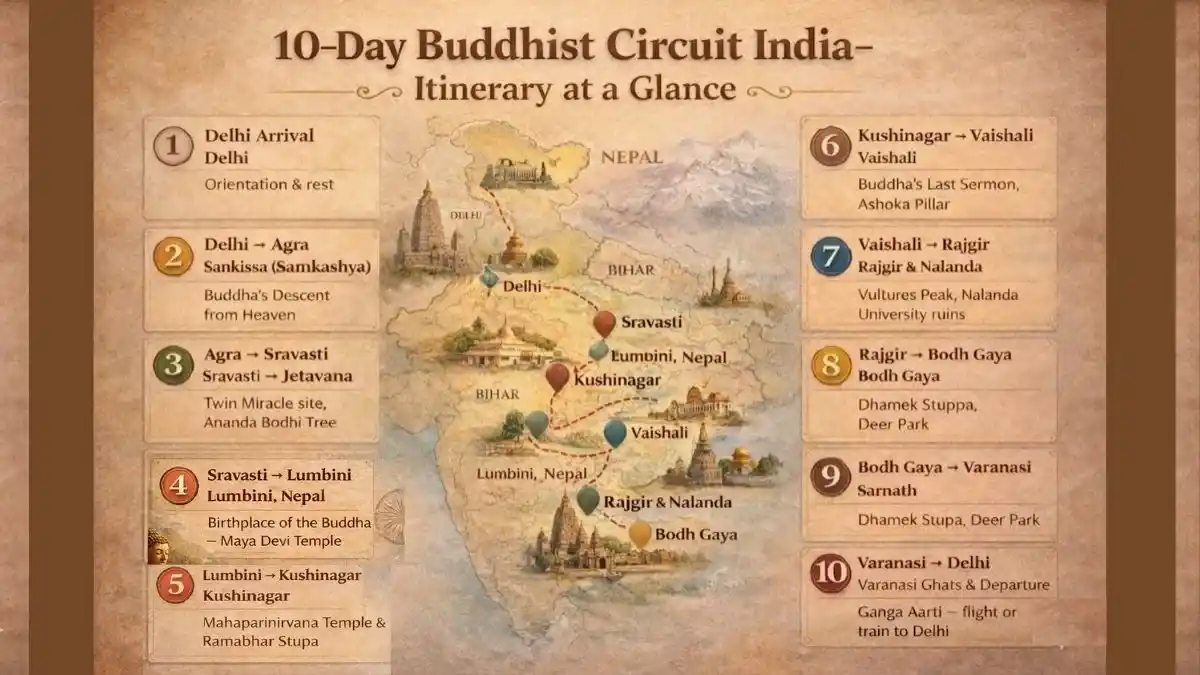
The following route departs from Delhi and returns to Delhi, covering all Eight Great Sacred Sites of Buddhism across India and Nepal. It is designed to minimise unnecessary travel time while maximising time at each sacred site.
| Day | From / To | Sacred Site | Key Highlight |
| 1 | Delhi Arrival | Delhi | Orientation & rest |
| 2 | Delhi → Agra | Sankissa (Samkashya) | Buddha’s Descent from Heaven |
| 3 | Agra → Sravasti | Sravasti — Jetavana | Twin Miracle site, Ananda Bodhi Tree |
| 4 | Sravasti → Lumbini | Lumbini, Nepal | Birthplace of the Buddha — Maya Devi Temple |
| 5 | Lumbini → Kushinagar | Kushinagar | Mahaparinirvana Temple & Ramabhar Stupa |
| 6 | Kushinagar → Vaishali | Vaishali | Buddha’s Last Sermon, Ashoka Pillar |
| 7 | Vaishali → Rajgir | Rajgir & Nalanda | Vultures Peak, Nalanda University ruins |
| 8 | Rajgir → Bodh Gaya | Bodh Gaya | Mahabodhi Temple, Sacred Bodhi Tree |
| 9 | Bodh Gaya → Varanasi | Sarnath | Dhamek Stupa, Deer Park |
| 10 | Varanasi → Delhi | Varanasi Ghats & Departure | Ganga Aarti — flight or train to Delhi |
✈️ Suggested Entry/Exit: Fly into Delhi (DEL) and out of Varanasi (VNS) for the most efficient routing or fly into Delhi and return from Delhi after the Varanasi conclusion. To take a tour across these famous Buddhist sites in India, luxury tempo traveller hire in Delhi is best way.
Day-by-Day Buddhist Tour India Itinerary
DAY 1 Arrival in Delhi | New Delhi
Arrive at Indira Gandhi International Airport, New Delhi. Transfer to your hotel and rest after your international flight. In the evening, visit the National Museum’s outstanding Buddhist art collection, which houses some of India’s finest Gandharan sculptures and Ashokan artefacts. A pre-tour briefing with your guide will orient you to the journey ahead. Overnight in Delhi.
🏨 Stay: ITC Maurya, The Leela Palace, or Paharganj area budget guesthouses depending on your travel style.
DAY 2 Delhi → Sankissa (Samkashya) → Agra | Sankissa, Uttar Pradesh
Depart early from Delhi toward Sankissa- one of the least-visited yet deeply sacred of the Eight Great Buddhist Places. Sankissa is where the Buddha is believed to have descended from the Tavatimsa Heaven after spending three months teaching his mother. The site contains a remarkable Ashoka Pillar and ancient stupa ruins. After exploration, continue to Agra for overnight stay.
Sankissa is frequently overlooked by standard Buddhist tour packages in India, including it sets this itinerary apart and fulfils the complete Eight Great Sites circuit. The site has a contemplative, unhurried atmosphere that is increasingly rare.
📍 Distance: Delhi to Sankissa: approximately 320 km (6 hours). Sankissa to Agra: approximately 165 km (3 hours).
Suggested Read: Agra Khajuraho Varanasi Trip Plan
DAY 3 Agra → Sravasti | Sravasti, Uttar Pradesh
Drive from Agra northward to Sravasti- the ancient capital of the Kosala Kingdom and the place where the Buddha spent an astonishing 25 rainy seasons during his teaching years. More than anywhere else, Sravasti was the Buddha’s home base. The Jetavana Monastery complex, gifted to the Buddha by the merchant Anathapindika, is one of the most atmospheric sites on the entire Buddhist circuit. The Ananda Bodhi Tree, grown from a cutting of the original Bodhi Tree in Bodh Gaya, still stands here. The Twin Miracle performed by the Buddha at Sravasti is commemorated by the Pakki Kuti and Kacchi Kuti stupas. You can also spend one day in Agra and witness the beauty of magnificent Taj Mahal and wonderful places to must visit in Agra.
Sravasti sees a fraction of the visitors of Bodh Gaya, making it one of the most serene and contemplative stops on the Buddhist pilgrimage circuit India has to offer. Overnight in Sravasti or nearby Balrampur.
🙏 Don’t Miss: The Japanese Peace Pagoda and the beautiful monastery garden at Jetavana at dawn- one of the most peaceful moments of the entire journey.
Suggested Read: 14 Days North India Itinerary
DAY 4 Sravasti → Lumbini (Nepal) | Lumbini, Nepal
Drive from Sravasti to the Indo-Nepal border at Sunauli, crossing into Nepal. Continue to Lumbini – the birthplace of Prince Siddhartha Gautama and one of the four holiest Buddhist pilgrimage sites in the world. Lumbini is a UNESCO World Heritage Site and has been developed into a remarkable sacred park under a masterplan by the Japanese architect Kenzo Tange.
The Maya Devi Temple marks the precise spot of the Buddha’s birth, with the remarkable Nativity Sculpture and the sacred Puskarini pond where Queen Maya Devi bathed before giving birth. The Ashokan Pillar, erected in 249 BCE by Emperor Ashoka on his own pilgrimage here, still stands with its original inscription. The surrounding Monastic Zone contains temples built by Buddhist nations including China, Japan, South Korea, France, Germany, Myanmar, and Cambodia. Overnight in Lumbini.
🛂 Nepal Visa: Most nationalities receive a visa on arrival at the Sunauli land border. Indian citizens do not require a visa. Cost approximately USD 25 for 15 days.
Note: (If you are not willing to visit Nepal, this day can be skipped)
DAY 5 Lumbini → Kushinagar | Kushinagar, Uttar Pradesh
Return to India and drive to Kushinagar- the place of the Buddha’s Mahaparinirvana, his final passing at the age of 80. Kushinagar is the most emotionally moving site on the entire Buddhist circuit. The Mahaparinirvana Temple houses the magnificent 6-metre reclining Buddha figure, believed to date to the 5th century CE, depicting the Buddha in his final moments of earthly existence.
The Ramabhar Stupa marks the site of the Buddha’s cremation. The surrounding archaeological zone contains ruins of numerous ancient monasteries. Unlike Bodh Gaya, Kushinagar receives comparatively few visitors, lending it a quieter, more intimate atmosphere for meditation and reflection. Temples built by Japan, China, Thailand, Myanmar, and Sri Lanka surround the main complex.
🕯️ Experience: Attend the evening prayer ceremony at one of the international monasteries – the Japanese or Thai temples often welcome visitors to join.
DAY 6 Kushinagar → Vaishali | Vaishali, Bihar
Drive from Kushinagar to Vaishali – one of the most historically significant yet undervisited Buddhist sites in India. Vaishali holds the distinction of being the world’s first republic and is where the Buddha delivered his final sermon before his passing, announcing his forthcoming Parinirvana. The famous episode of a monkey offering honey to the Buddha occurred here.
The Lion Capital Ashoka Pillar at Vaishali is one of the finest in India. The Ananda Stupa, the Relic Stupa, and the Coronation Tank of the Licchavis complete the main complex. Vaishali is also deeply significant in Jain tradition as the birthplace of Mahavira. Continue to Patna or Rajgir for overnight stay.
📜 Historical Note: Vaishali hosted the Second Buddhist Council approximately 100 years after the Buddha’s passing – a watershed moment in Buddhist history when the Sangha first began to diverge into different schools.
DAY 7 Rajgir & Nalanda | Bihar
Spend a full day at two of the most intellectually significant Buddhist sites in India. Rajgir – the ancient capital of the Magadha Empire – was where the Buddha spent 12 years of his ministry. The Griddhakuta Hill (Vulture’s Peak) is where he delivered many of his most important Mahayana teachings, including the Heart Sutra and the Lotus Sutra. The site also features the Venuvan Bamboo Grove, the Buddha’s first monastery gifted by King Bimbisara, and the hot springs sacred to Hindus and Buddhists alike. The Japanese Peace Pagoda on a nearby hill commands spectacular views.
Nalanda – just 15 kilometres from Rajgir – was the greatest university of the ancient world, attracting scholars from across Asia for over 700 years from the 5th to the 12th century CE. The archaeological ruins of Nalanda University spread across a vast campus and the Nalanda Archaeological Museum houses outstanding Buddhist sculptures and artefacts. Overnight in Rajgir or Bodh Gaya.
DAY 8 Bodh Gaya | Bodh Gaya, Bihar
Arrive in Bodh Gaya – the holiest site in all of Buddhism and the most important destination on the entire Buddhist pilgrimage circuit India. This is where Prince Siddhartha Gautama sat beneath the Bodhi Tree and, after 49 days of meditation, attained supreme enlightenment and became the Buddha. The Mahabodhi Temple, a UNESCO World Heritage Site, rises 55 metres above the sacred spot, housing a gilded image of the Buddha in the earth-touching mudra.
The Bodhi Tree- a direct descendant of the original fig tree under which the Buddha sat- still stands today, its spreading branches the focal point of prayer and meditation for pilgrims from across the world. The Vajrasana (Diamond Throne) marks the precise seat of enlightenment. The surrounding grounds contain the Animisalocana Chaitya, the Ratnacankama (Jewel Walk), and the Lotus Pond. Over 150 international monasteries surround the main complex – representing every major Buddhist nation and tradition.
🌅 Must Experience: Arrive at the Mahabodhi Temple at dawn before the crowds. Sitting beneath the Bodhi Tree in the early morning light, surrounded by chanting monks from Thailand, Myanmar, Tibet, Japan, and Sri Lanka, is an experience unlike any other on earth.
In the evening, attend the spectacular candlelight meditation ceremony at the Mahabodhi Temple. Many visitors find Bodh Gaya so profound that they linger here for several days. Overnight in Bodh Gaya.
DAY 9 Bodh Gaya → Sarnath → Varanasi | Sarnath, Uttar Pradesh
Drive or fly from Bodh Gaya to Varanasi, stopping at Sarnath 13 kilometres north of Varanasi- the site of the Buddha’s first sermon and one of the four holiest Buddhist pilgrimage sites in the world. After attaining enlightenment at Bodh Gaya, the Buddha walked to Sarnath’s Deer Park, where he encountered his five former disciples and delivered the Dhammacakkappavattana Sutta- the Setting in Motion of the Wheel of Dharma. This first sermon established the Four Noble Truths and the Noble Eightfold Path, the foundational teachings of Buddhism.
The Dhamek Stupa- 43 metres tall and built by Emperor Ashoka marks the precise location of the first sermon. The Ashoka Pillar, topped by the Lion Capital that became India’s national emblem, originally stood here. The Sarnath Archaeological Museum houses the original Lion Capital along with some of India’s finest Buddhist sculptures. Like Bodh Gaya, Sarnath has monasteries representing China, Japan, Korea, Burma, Tibet, and Sri Lanka.
Continue to Varanasi for the legendary evening Ganga Aarti ceremony at the Dashashwamedh Ghat- a magnificent river of light and devotion on the sacred Ganges. Overnight in Varanasi.
DAY 10 Varanasi Ghats & Departure | Varanasi
Rise before dawn for a sunrise boat ride on the Ganges- one of the most iconic experiences in all of India. The ancient ghats of Varanasi, with their steps descending to the sacred river, have witnessed the flow of Indian civilization for thousands of years. The city itself is considered by Hindus to be the place where liberation is granted- and its profound spiritual energy is palpable to visitors of all faiths.
After the boat ride, visit the Banaras Hindu University’s Bharat Kala Bhavan museum, which houses an exceptional collection of Buddhist art. Transfer to Varanasi’s Lal Bahadur Shastri International Airport for your departure flight or connect onward to Delhi for international flights.
Practical Information for Your Buddhist Tour of India
Best Time to Visit Buddhist Sites in India
October to March is the ideal season for a Buddhist pilgrimage tour of India. The weather across Bihar and Uttar Pradesh is cool and dry- perfect for outdoor exploration of the archaeological sites. November is particularly special as it coincides with the Kagyu Monlam (great prayer festival) at Bodh Gaya. The months of April to June are very hot and June to September sees heavy monsoon rains. December to February is the peak pilgrimage season, especially around Buddha Purnima (April/May) and the winter prayer festivals.
How to Get Around- Buddhist Circuit Transport
- Private car and driver: Innova Crysta on Rent is the most flexible and comfortable option for groups of 3 to 6- allows full control over timing at each site. For big groups of 8 or more, Urbania Van hire in Delhi is very comfortable.
- IRCTC Buddhist Circuit Tourist Train: An 8-day train covering Bodh Gaya, Rajgir, Nalanda, Sarnath, Lumbini, Kushinagar, and Sravasti- a unique and comfortable option for solo travellers
- Domestic flights: Patna (PAT) and Varanasi (VNS) airports serve the circuit well for saving time on long road legs
- Shared taxis: Available between major sites for budget travellers- slower but authentic. You can also book Bus on rent in Delhi for Buddhist Tour in India. It makes your journey very comfy, budget-friendly.
Visa Requirements
India offers e-Visas to citizens of most countries, obtainable online. Apply at least 5 to 7 days before travel. If visiting Lumbini in Nepal, apply for a double-entry Indian e-Visa. Nepal offers visa on arrival at the Sunauli land border for most nationalities.
| Category | Budget | Mid-Range / Comfort |
| Accommodation/night | USD 10–20 | USD 40–90 |
| Meals/day | USD 6–10 | USD 20–35 |
| Local transport/day | USD 5–10 | USD 25–50 |
| Site entry fees | USD 1–5 per site | Same |
| Estimated Daily Total | USD 22–45 | USD 85–175 |
| 10-Day Trip Total | USD 220–450 | USD 850–1750 |
What to Pack for a Buddhist Pilgrimage
- Modest clothing – cover shoulders and knees at all temple and monastery sites
- Slip-on shoes – you will remove footwear at every sacred site
- A light shawl or meditation cushion for long sittings at major temples
- A good torch or headlamp for early dawn visits to sites
- Hand sanitiser, water purification tablets, and basic medications
- A journal – the experience of this journey invites reflection
Why This Buddhist Tour Will Change You?
There is a quality to the Buddhist sacred sites of India that is difficult to articulate and impossible to forget. Part of it is the sheer antiquity – these places have been visited by pilgrims continuously for over two millennia. Part of it is the living presence of the global Buddhist community that gathers here – monks in saffron, burgundy, grey, and white from Thailand, Myanmar, Tibet, Sri Lanka, Japan, Korea, and Vietnam, all united in a shared reverence for the same teacher and the same teachings.
India’s Buddhist circuit is not merely a tourist itinerary. It is a pilgrimage in the truest sense- a journey that moves not just through space, but through time, through history, and, for many who make it, through their own understanding of what it means to be fully human.
Start planning your Buddhist tour of India today. The Bodhi Tree is waiting.
