
Picking a best vehicle for Rajasthan family trip feels like a small decision until you’re four hours into a desert highway with cranky kids, a grandmother who needs to stretch her legs, and luggage stacked on laps because the boot filled up in Jaipur. The right vehicle doesn’t just move your family from one city to the next, it decides whether the trip itself is remembered fondly or gets filed away as “never again.” Rajasthan’s distances are long, its roads swing between smooth highways and rougher rural stretches, and its weather is extreme in both directions. Here’s how to actually think through this choice instead of just booking whatever shows up first in a search.
Start With Group Size, Not Preference
The single biggest mistake families make is picking a vehicle based on what looks comfortable in photos rather than what actually fits their headcount plus luggage. A family of five with two suitcases and a cooler needs something very different from a joint family of fourteen travelling together for a wedding or a festival trip.
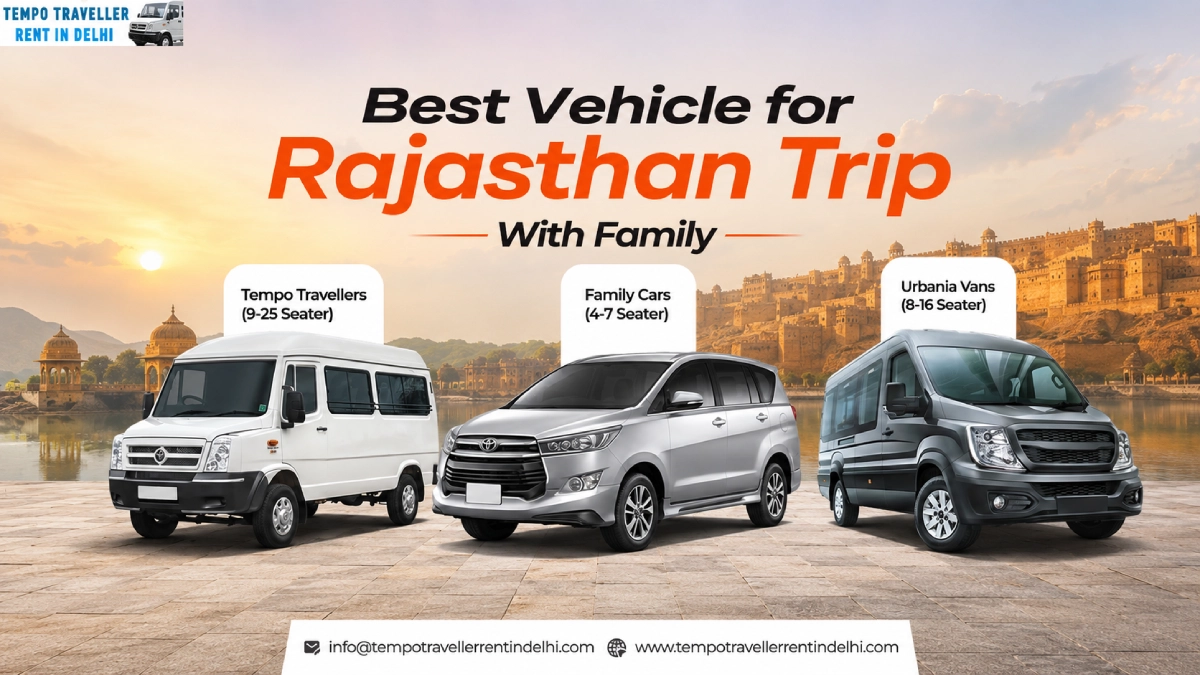
For smaller families, somewhere between 6 and 9 people, a compact option like the 8 seater tempo traveller or a 9 seater tempo traveller works well without feeling like overkill. These are easier to park near forts and old-city markets where lanes are narrow, and they’re more fuel-efficient over the long Rajasthan distances.
Once you cross 10-12 travellers, a 10 seater tempo traveller or 16 seater tempo traveller makes far more sense than splitting the group across two cars. Splitting a family across vehicles sounds harmless until you realise it also splits the experience. Half the group misses the impromptu stop at a roadside dhaba, the songs, the arguments about which route to take. Larger groups of 18 to 26 travelling for weddings, reunions, or bigger family functions across Rajasthan often move to an 18 seater, 22 seater, or 26 seater tempo traveller, which keeps everyone together and cuts the overall cost per head significantly compared to hiring multiple cars.
Why an SUV or Sedan Often Falls Short
A lot of families default to a sedan or SUV because it’s familiar, but for Rajasthan specifically, this choice comes with real trade-offs. Boot space fills up fast once you factor in suitcases, a cooler, maybe a stroller or a folding chair for elderly members, and shopping picked up along the way in Jaipur or Jodhpur’s markets. Seating in a sedan also puts three adults shoulder to shoulder in the back for a 5-6 hour stretch, which gets uncomfortable well before you reach your destination.
SUVs like Innova Crysta on Rent solve some of this but still cap out around 7 seats including the driver, which doesn’t leave room to grow if one more cousin decides to join at the last minute.
There’s also the driving factor. Rajasthan’s highways are generally well maintained, but a family road trip tends to mean one person, often the same person every time, doing all the driving across multiple days. That’s tiring and, frankly, a little risky over long stretches through desert heat. A vehicle with a professional driver removes this problem entirely and lets every adult in the family actually be present for the trip instead of white-knuckling a highway at hour eight.
Tempo Traveller vs Force Urbania: What’s Actually Different
If you’re choosing between a standard tempo traveller and the newer Force Urbania, the difference comes down to how much you value cabin design and seat comfort over cost. Urbania has a more modern, coach-like build with pushback seating and noticeably better legroom, which some families find worth the extra spend, particularly for trips involving overnight travel or elderly passengers who need to recline properly to rest.
Tempo Travellers remain the more budget-friendly, reliable option and are still the more common choice for most Rajasthan family trips because they hit a sensible balance between comfort and cost. If you want a proper side-by-side before deciding, this comparison of Urbania Van versus Tempo Traveller breaks down seating, features, and where each one makes more sense.
For families who want to go a step up without jumping all the way to Urbania, the Maharaja Tempo Traveller variant is worth considering too. It’s built specifically for exactly this kind of trip, long heritage circuits through desert states with older or younger passengers in the group, and the difference in fatigue by the end of a multi-day circuit is noticeable. There’s a detailed breakdown of what makes the Maharaja Tempo Traveller worth the upgrade if comfort is a bigger priority than shaving off cost.
What to Actually Check Before Booking Best Vehicle for Rajasthan Family Trip
Rajasthan’s heat, particularly outside the winter months, makes air conditioning non-negotiable rather than a nice-to-have. Check whether the vehicle has a functioning music system if you’ve got teenagers or younger kids who’ll get restless on longer stretches between cities like Jodhpur and Jaisalmer. Charging ports matter more than people expect, since phones double as cameras, maps, and entertainment for the whole trip. Ask specifically about luggage capacity, not just seat count, because a vehicle rated for 12 passengers with all seats full might genuinely struggle to fit 12 people’s worth of bags for a week-long trip.
It’s also worth asking about driver experience with the specific route you’re planning. Someone who’s driven the Jaipur-Jodhpur-Jaisalmer stretch dozens of times will know where to stop for a proper meal, which sections get congested near festival dates, and how to time arrivals to avoid reaching a fort or palace right as tour buses unload. A few other basics, like advance payment terms, per-kilometre charges versus fixed packages, and what happens if plans change mid-trip, are worth confirming upfront. This rundown of things to check before booking a tempo traveller covers most of what catches first-time bookers off guard.
Matching the Vehicle to Your Actual Itinerary
A family doing a tight loop of Jaipur, Pushkar, and Udaipur over five days has different needs than one attempting the longer haul out to Jaisalmer and back. Longer desert stretches favour a vehicle with better seat recline and stronger air conditioning, since you’ll spend more consecutive hours on the road with fewer city breaks. Shorter, city-hopping itineraries can work fine with a smaller, more nimble vehicle that’s easier to navigate through old-city lanes in Jaipur or Udaipur, where wider vehicles sometimes struggle with tight turns.
If your Rajasthan trip includes a genuine desert leg out to Jaisalmer, it’s worth reading through a full Delhi to Jaisalmer route guide before finalising your vehicle, since the distances involved change what “comfortable” actually means for your family.
Seasonal Factors That Change the Calculation
Rajasthan’s weather swings hard between seasons, and the vehicle that feels perfectly fine in December can feel completely wrong in May. Between April and June, daytime temperatures regularly cross 42-45°C in cities like Jaisalmer and Bikaner, and a weak or overworked air conditioning system stops being a minor annoyance and becomes a genuine health concern for young kids and older family members. If your trip falls in this window, ask specifically about the vehicle’s AC capacity relative to seat count, since a system built for 9 passengers struggling to cool a fully loaded 12-seater is a common complaint.
Winter trips, particularly through December and January, bring their own consideration. Early morning starts from Delhi can mean dense fog on the highway, and desert nights in places like Jaisalmer drop close to freezing even though the days stay pleasant. A vehicle with good sealing and heating, along with blankets for the group, makes a real difference on early departures or late-night arrivals.
Monsoon season, while less popular for Rajasthan trips generally, does bring its own driving challenges on some rural stretches, so a vehicle with a driver experienced in wet-road conditions matters more than usual if you’re travelling between July and September. For a pilgrimage trip with bigger group, rather than close family members, you can also consider hiring Minibus on Rent.
Budgeting for the Right Vehicle Without Overspending
Families often assume the biggest vehicle is automatically the safest financial choice because it “fits everyone comfortably,” but oversized vehicles for a smaller group waste money on fuel and per-kilometre charges without adding real comfort. The better approach is to count your actual travellers, add a little buffer for luggage and occasional extra passengers, and book accordingly rather than upgrading a size or two “just in case.”
On the other end, cramming a large joint family into a vehicle that’s technically rated for their headcount but leaves no breathing room for bags or stretching legs tends to backfire by day two of a multi-day trip. Getting this balance right upfront saves both money and arguments once you’re actually on the road.
It also helps to ask upfront whether pricing is per kilometre or a fixed package, since Rajasthan trips often involve long single-day drives where per-kilometre rates can add up quickly compared to a flat outstation package. Toll charges, driver allowances, and state entry taxes are, more often than not, separate from the base rental cost, so a quick conversation about the full expected bill avoids surprises when you’re settling up at the end of the trip.
Suggested Read: Epic Route Plan for Delhi to Rajasthan Road Trip
The Real Bottom Line
There’s no single best vehicle for Rajasthan family trip. What matters is being honest about your group size, your actual itinerary, and how much comfort your family needs to stay in good spirits across multiple days on the road. Get those three things right, book with a company that maintains its fleet properly and pairs you with an experienced driver, and the vehicle stops being a logistics problem and becomes just another part of a good trip. Read Rajasthan Destination Guides before planning a trip for better idea about route, distance and best season.
Frequently Asked Questions
Which vehicle is best for a family road trip in Rajasthan?
For families of 6-9, a 9 seater tempo traveller offers a good balance of comfort and cost. Larger families or groups of 10 and above are, more often than not, better off with a 16 seater or 18 seater tempo traveller rather than splitting across two cars.
Is a tempo traveller better than an SUV for a Rajasthan trip?
For groups of 6 or more, yes. An SUV runs out of boot space and legroom quickly once you add luggage for a multi-day trip, while a tempo traveller offers more seating flexibility, better luggage capacity, and comes with a professional driver so no family member has to drive the long desert stretches.
How many seater tempo traveller do I need for 12 people?
A 16 seater tempo traveller is the usual choice for a group of 12, since it leaves enough spare room for luggage without the group feeling cramped. Booking exactly to headcount with no buffer tends to feel tight on multi-day trips.
What is the difference between Tempo Traveller and Force Urbania?
Urbania has a more modern, coach-style cabin with better pushback seating and legroom, making it a stronger choice for overnight or long hill drives. Tempo Traveller remains the more budget-friendly option and still works well for most standard Rajasthan itineraries.
Is AC necessary for a Rajasthan road trip vehicle?
Yes, particularly outside the winter months. Rajasthan’s desert districts regularly cross 40°C between April and June, and a vehicle with strong, reliable air conditioning matters far more here than on cooler hill routes.
How much does a tempo traveller cost for a Rajasthan trip?
Pricing is generally charged per kilometre for outstation trips, with rates varying by seater size, and driver allowance, tolls, and state taxes charged separately from the base fare. It’s worth confirming whether a quote is a flat package or a per-km rate before booking.
Is Maharaja Tempo Traveller worth the extra cost for a family trip?
For longer circuits covering multiple Rajasthan cities, or for groups travelling with elderly members or young children, the Maharaja variant’s recliner seating and extra comfort noticeably reduce fatigue over multi-day drives. For shorter, single-city trips, a standard tempo traveller is generally sufficient.
