

Complete Road Trip Itinerary with Route Map, Distances & Darshan Guide
8 Days · ~2,027 km · Madhya Pradesh & Maharashtra · Departing Delhi
Of the twelve sacred Jyotirlingas that mark Lord Shiva’s most powerful earthly manifestations, five form a natural circuit across Madhya Pradesh and Maharashtra- a route that begins in the ancient temple-city of Ujjain and sweeps through the sacred Narmada riverbanks, the Sahyadri hills, and the historic Deccan Plateau before concluding near the UNESCO-listed Ellora Caves. For devotees and spiritual travellers departing from Delhi, this 8-day Panch Jyotirlinga Yatra is among the most profound pilgrimages accessible by road in all of India.
This blog covers the complete 5 Jyotirlinga tour from Delhi with a detailed day-by-day itinerary, accurate route map and road distances, darshan timings, en-route highlights like Shirdi and Ellora, practical travel tips, and everything you need to plan this sacred journey with confidence and devotion.
🔱 The Five Jyotirlingas Covered: Mahakaleshwar (Ujjain, MP) · Omkareshwar (Khandwa, MP) · Trimbakeshwar (Nashik, MH) · Bhimashankar (Pune District, MH) · Grishneshwar (Aurangabad, MH)
The Sacred Significance of the Jyotirlingas
A Jyotirlinga meaning ‘Radiant Pillar of Light’ is a shrine where Lord Shiva is believed to have manifested as an infinite column of light, a form beyond beginning or end. Of the 64 original Jyotirlingas described in the Shiva Purana, 12 are considered supremely sacred, each carrying unique spiritual energy, mythology, and architectural heritage. A pilgrimage to all 12 is believed to liberate the devotee from the cycle of birth and death.
The five Jyotirlingas covered in this tour span two states and four distinct landscapes- the ancient royal city of Ujjain on the Shipra River, the sacred island of Omkareshwar on the Narmada, the forested Sahyadri hills of Bhimashankar, the Godavari-source temple of Trimbakeshwar, and the red-basalt marvel of Grishneshwar beside the Ellora Caves. Together they form one of India’s most spiritually rewarding road circuits.
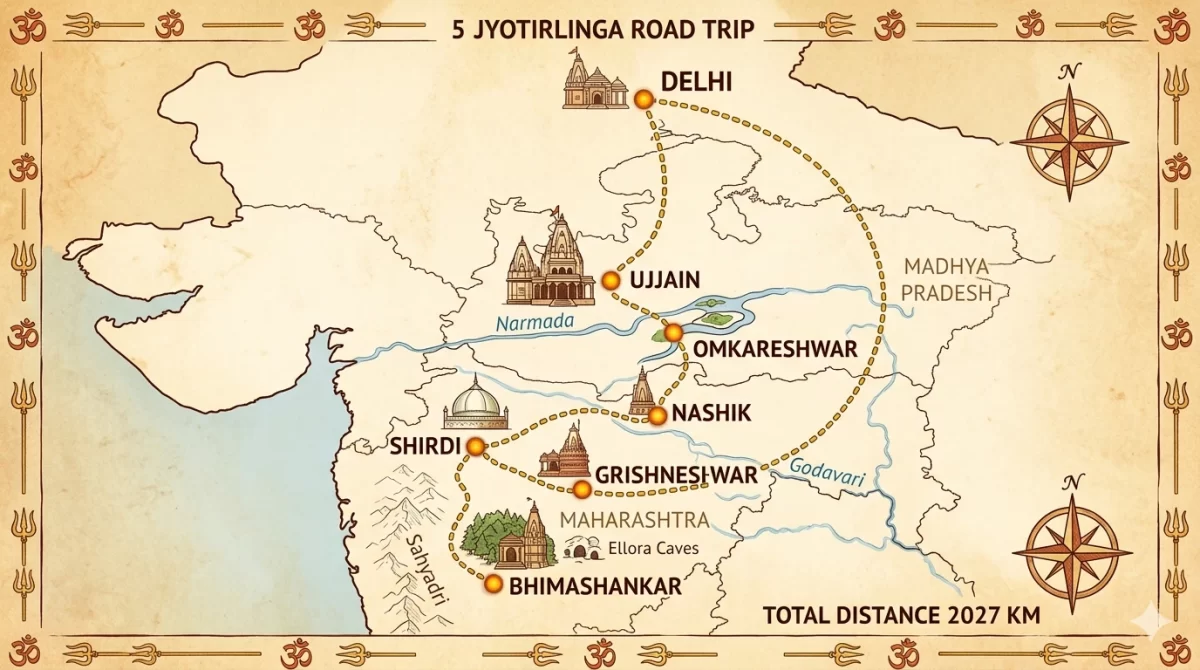
Complete Route Map & Distance Chart
The 5 Jyotirlinga road trip from Delhi covers approximately 2,027 kilometres one way and passes through the states of Uttar Pradesh, Madhya Pradesh, and Maharashtra. The route is well-served by national highways throughout and can be completed comfortably in a private car, SUV, or Tempo Traveller.
| Day | Route Leg | Jyotirlinga / Highlight | km | Drive | Night Stay |
| 1 | Delhi → Ujjain | Mahakaleshwar Jyotirlinga | 780 | 11–12 h | Ujjain |
| 2 | Ujjain Exploration | Bhasma Aarti · Kal Bhairav · Ram Ghat | — | — | Ujjain |
| 3 | Ujjain → Omkareshwar | Omkareshwar Jyotirlinga | 133 | 2.5 h | Omkareshwar |
| 4 | Omkareshwar → Nashik | En route · Overnight drive | 550 | 9–10 h | Nashik |
| 5 | Nashik → Trimbakeshwar → Shirdi | Trimbakeshwar Jyotirlinga | 28 + 90 | 4 h | Shirdi |
| 6 | Shirdi → Bhimashankar → Pune | Bhimashankar Jyotirlinga | 186+123 | 7 h | Pune/Aurangabad |
| 7 | Pune/Aur → Grishneshwar → Ellora | Grishneshwar Jyotirlinga + Ellora | 100–175 | 3–4 h | Aurangabad |
| 8 | Aurangabad → Delhi | Fly or overnight train | — | — | Delhi |
Recommended Vehicle: For a group of 8 to 9 pilgrims, 9 Seater Tempo Traveller or Innova Crysta on Rent provides the best comfort over 8 days. Hire a vehicle with driver from Delhi for an all-inclusive experience.
Leg-by-Leg Distance & Highway Guide
The table below gives precise road distances, drive times, and the key highways for each leg of the journey. All distances are approximate and may vary based on route variations and real-time road conditions.
| Route Leg | Distance | Drive Time | Road / Highway |
| Delhi → Ujjain | 780 km | 11–12 hrs | NH48 via Agra → Gwalior |
| Ujjain → Omkareshwar | 133 km | 2.5 hrs | NH52 via Indore bypass |
| Omkareshwar → Nashik | 550 km | 9–10 hrs | NH52 → NH160 via Dhule |
| Nashik → Trimbakeshwar | 28 km | 45 min | State Hwy SH-50 |
| Trimbakeshwar → Shirdi | 90 km | 1.5 hrs | NH160 / State Hwy |
| Shirdi → Bhimashankar | 186 km | 4 hrs | NH61 via Ahmednagar |
| Bhimashankar → Aurangabad | 230 km | 5 hrs | NH60 via Pune bypass |
| Aurangabad → Grishneshwar | 30 km | 45 min | Aurangabad–Ellora Rd |
| TOTAL (approx.) | ~2,027 km | ~36 hrs | One-way circuit |
📱 Navigation Tip: Use Google Maps offline or the Mappls (MapMyIndia) app — particularly helpful in rural Maharashtra where mobile data can be patchy. Download offline maps for MP and Maharashtra before departure.
Day-by-Day Itinerary for 5 Jyotirlinga Tour from Delhi
DAY 1 Delhi → Ujjain | 780 km · ~11–12 hrs drive
Depart from Delhi in the early morning, ideally by 5:00 AM to maximise driving time and arrive in Ujjain by evening. The route follows NH48 from Delhi toward Agra (passing the Yamuna Expressway), then continues on NH44 and state highways through Gwalior, Shivpuri, and Guna before reaching Ujjain via Dewas. The drive through Madhya Pradesh is pleasantly rural with good road surfaces on the national highway sections. Ujjain is one of the best cultural sites to visit in Madhya Pradesh.
Arrive in Ujjain by 6:00 to 7:00 PM. Check into your hotel and freshen up. If you arrive in time, attend the spectacular evening Sandhi Aarti at the Mahakaleshwar Temple- one of the most atmospherically powerful temple ceremonies in India, with priests performing abhishek to the sound of Vedic chants and drums. Retire early to prepare for the pre-dawn Bhasma Aarti.
🏨 Stay in Ujjain: Hotel Shipra (MPTDC), Ramada by Wyndham Ujjain, or dharamshalas near the temple for budget pilgrims.
DAY 2 Ujjain- Full Day Exploration
Wake up early at 2:30 AM and proceed to the Mahakaleshwar Temple to register for the legendary Bhasma Aarti- the most unique and spiritually electrifying ritual in all of Ujjain, performed daily at 4:00 AM. In this extraordinary ceremony, the deity is adorned with sacred ash (bhasma) from the cremation ground symbolising the Mahakal aspect of Lord Shiva as the master of time and death. Witnessing this aarti is considered the greatest blessing of the entire pilgrimage. Advance online booking is strongly recommended, as slots fill days in advance.
After the Bhasma Aarti and darshan, spend the morning exploring Ujjain’s remarkable spiritual landscape. The Kal Bhairav Temple- dedicated to the fierce guardian deity of Ujjain is a must-visit, famous for the extraordinary tradition of offering liquor to the deity. The Ram Ghat on the Shipra River is one of Ujjain’s most serene spots for prayer and river bathing. The Harsiddhi Temple, one of the 51 Shakti Peethas, and the ancient Sandipani Ashram where Lord Krishna received his education, round out a deeply enriching day in one of India’s seven sacred cities.
You can also extend your trip with visit to most recommended places near Ujjain.
⏰ Bhasma Aarti Booking: Book online at mahakaleshwar.org at least 3 to 5 days in advance. The aarti begins at 4:00 AM sharp. Carry original ID proof for entry.
DAY 3 Ujjain → Omkareshwar | 133 km · ~2.5 hrs drive
After an early breakfast, drive south from Ujjain on NH52 toward Indore (approximately 55 kilometres), then continue to Omkareshwar- a total distance of 133 kilometres through the green heartland of Madhya Pradesh. The final approach to Omkareshwar is spectacular: the road descends to the sacred Narmada River, and the island of Mandhata- shaped, remarkably, like the sacred Sanskrit symbol Om- appears in the river below.
Omkareshwar is one of the most naturally beautiful of all the Jyotirlinga sites. The sacred island, surrounded by the turquoise waters of the Narmada, is connected to the mainland by a footbridge. The Omkareshwar Jyotirlinga Temple houses one of the twelve self-manifested (swayambhu) Shiva Lingas. The Mamleshwar Temple on the south bank of the Narmada is also considered part of the Omkareshwar Jyotirlinga.
Take a boat ride around the island for a breathtaking aerial-level view of the Om-shaped landform- one of India’s most remarkable natural sacred formations. Attend the evening aarti at the riverside ghats as lamps are floated on the Narmada at dusk. Overnight in Omkareshwar or Indore.
🚣 Boat Ride: The 20-minute circular boat ride around Mandhata Island (INR 50–80 per person) offers the best perspective on the island’s sacred Om shape — do not skip it.
DAY 4 Omkareshwar → Nashik (Overnight Drive) | 550 km · ~9–10 hrs drive
This is the longest driving day of the trip- the 550-kilometre stretch from Omkareshwar to Nashik via Dhule and NH160. Depart after breakfast and drive steadily southward, crossing into Maharashtra. The road passes through the Satpura foothills and the flat Deccan plateau before the landscape gradually becomes more rugged approaching the Western Ghats. Arrive in Nashik by evening and check into your hotel. Rest and prepare for an early morning temple visit.
Nashik itself is one of the four cities that host the Kumbh Mela- the largest religious gathering on earth and is steeped in Ramayana mythology. The Panchavati area, where Lord Rama, Sita, and Lakshmana are said to have spent their forest exile, contains the sacred Ramkund bathing ghat on the Godavari River, the Kalaram Mandir, and the Sita Gufa (cave). An evening visit to Panchavati is deeply worthwhile.
🛣️ Driving Note: Consider splitting this leg with an overnight stop in Dhule (halfway point, approximately 270 km from Omkareshwar) if your group prefers a more relaxed pace.
DAY 5 Nashik → Trimbakeshwar → Shirdi | 28 + 90 km · ~3–4 hrs drive
Wake up early and drive the 28 kilometres from Nashik to Trimbakeshwar- one of the most sacred and architecturally magnificent Jyotirlinga temples in India. Trimbakeshwar is unique among all Jyotirlingas for its three-faced linga, representing the holy trinity of Brahma, Vishnu, and Mahesh (Shiva) making a single darshan here equivalent, spiritually, to the combined blessings of all three. The temple is also the source of the sacred Godavari River, born from the Brahmagiri Hills behind the temple.
The temple architecture is outstanding- built in classic Hemadpanthi style with intricately carved black stone, the 18th-century structure is one of Maharashtra’s finest. The Kushavarta Kund within the temple complex is a sacred tank considered the origin of the Godavari. Darshan timings begin at 5:30 AM- arrive early to avoid the late-morning crowds. After darshan, drive 90 kilometres east to Shirdi- the home of Sai Baba for an afternoon visit to the Saibaba Samadhi Mandir, one of India’s most visited temples. Overnight in Shirdi.
📿 Rudrabhishek: Arrange a Rudrabhishek puja at Trimbakeshwar in advance through the temple trust. This deeply meaningful ritual takes approximately 45 minutes and costs INR 500–2,000 depending on the ritual level.
DAY 6 Shirdi → Bhimashankar → Aurangabad | 186 + 123 km · ~6–7 hrs drive
Depart Shirdi after an early morning Saibaba darshan and drive 186 kilometres south via Ahmednagar to reach Bhimashankar- the most sacred sited of the five Jyotirlingas on this circuit. Bhimashankar is tucked into the dense forests of the Sahyadri mountains at 1,033 metres elevation, and the final 20-kilometre approach road winds through the Bhimashankar Wildlife Sanctuary- home to the Indian Giant Squirrel, leopards, and rich birdlife. The drive itself is an experience.
The Bhimashankar Temple is built in the Nagara architectural style and is believed to be the site where Lord Shiva defeated the demon Tripurasura. The Bhima River- which eventually flows through Pune, Solapur, and into the Krishna originates from this temple complex. The cool, misty, forested setting makes Bhimashankar one of the most spiritually serene stops on the entire circuit. After darshan, continue 123 kilometres to Pune or 230 kilometres to Aurangabad for overnight stay, depending on your next day’s plan.
🌿 Wildlife Note: The Bhimashankar Wildlife Sanctuary is a notified reserve. The forest department charges a nominal entry fee for the sanctuary area surrounding the temple. The Indian Giant Squirrel (Shekru) — Maharashtra’s state animal — is frequently spotted in the temple surroundings.
DAY 7 Aurangabad → Grishneshwar → Ellora Caves | 30 return km · ~1 + sightseeing hrs drive
Drive 30 kilometres from Aurangabad to Verul village for darshan at Grishneshwar- the twelfth and last of India’s 12 Jyotirlingas in the traditional enumeration. Completing this darshan effectively closes the sacred Jyotirlinga circuit. Grishneshwar (also written Ghrishneshwar or Ghrneshwar) is the smallest of the 12 Jyotirlingas in physical size but carries profound spiritual significance- it is intimately connected with the legend of a devoted woman named Kusuma whose extraordinary faith compelled Lord Shiva to manifest permanently at this spot.
The temple is built in brilliant red Dectocan basalt in classical Hemadpanthi style with five-tier shikhara and exquisitely carved panels depicting scenes from Shiva Purana. Morning darshan begins at 5:30 AM- arrive early to witness the abhishek ceremony. After darshan, walk 500 metres to the entrance of the Ellora Caves- one of India’s greatest archaeological wonders and a UNESCO World Heritage Site. The Kailasa Temple (Cave 16), carved entirely from a single basalt cliff and dedicated to Lord Shiva, is considered one of the greatest architectural achievements of the ancient world and connects powerfully with the sacred energy of the day’s Jyotirlinga pilgrimage.
🏛️ Ellora Caves: Allow at least 3 hours for Ellora Caves 1–12 are Buddhist, 13–29 are Hindu, and 30–34 are Jain. The Kailasa Temple (Cave 16) alone deserves an hour. Entry fee for foreigners: INR 600, For Indian: Rs 40. Find all details to explore this heritage site in Ajanta Ellora Caves Guide.
DAY 8 Aurangabad- Departure to Delhi
Conclude your Panch Jyotirlinga Yatra from Aurangabad. This road trip will be longest that will take approx 20-24 hours with 2-3 breaks. For those who prefer to return by road, the Delhi-Aurangabad driving route via Indore and Gwalior is approximately 1,200 kilometres.
Note: The most practical return options are a flight from Aurangabad Airport (IXU) to Delhi’s Indira Gandhi International Airport- approximately 2 hours in the air or the overnight train, with the Devgiri Express connecting Aurangabad to Delhi Hazrat Nizamuddin in approximately 18 hours.
Before departing, take a moment to reflect on the journey completed. You have visited five of India’s most sacred Shiva shrines, crossed two states, witnessed Vedic rituals that have been performed continuously for thousands of years, and traversed landscapes ranging from the sacred Narmada valley and the Deccan Plateau to the forest-covered Sahyadri hills. 5 Jyotirlinga tour from Delhi is not merely a road trip- it is a yatra in the truest sense.
Temple Darshan Timings- All 5 Jyotirlingas
All temples open early for morning rituals and close late evening. Plan your arrivals at each temple as early as possible- morning darshan is both less crowded and more spiritually charged.
| Jyotirlinga | State | Darshan Timings | Special Ritual |
| Mahakaleshwar | MP – Ujjain | 4:00 AM – 11:00 PM | Bhasma Aarti (4:00 AM) |
| Omkareshwar | MP – Khandwa | 5:00 AM – 10:00 PM | Boat ride to island |
| Trimbakeshwar | MH – Nashik | 5:30 AM – 9:00 PM | Rudrabhishek Puja |
| Bhimashankar | MH – Pune Dist. | 4:30 AM – 9:30 PM | Panchamrit Abhishek |
| Grishneshwar | MH – Aurangabad | 5:30 AM – 9:30 PM | Morning Abhishek |
🔱 Important Note: Darshan timings may vary during Shravan month (July–August), Mahashivratri, and other major festivals when the temples remain open for extended hours and attract enormous crowds. Check official temple websites before travel.
A Journey Measured Not in Kilometres, But in Grace
The 5 Jyotirlinga tour from Delhi is not merely a road trip across two states. It is a yatra- a sacred journey in which every kilometre driven, every dawn aarti attended, every sacred river crossed, and every ancient Shiva Linga before which you bow your head is part of a continuous conversation between the human and the divine. To complete this trip in comfort and convenience, book Tempo Traveller on Rent in Delhi– available in multi seater options of 9 to 25 persons.
From the Bhasma Aarti of Mahakaleshwar where time itself seems to stop at 4 AM, to the Om-shaped island of Omkareshwar rising from the Narmada, to the forest-hidden energy of Bhimashankar, to the three-faced divinity of Trimbakeshwar, to the quiet completeness of Grishneshwar beside the ancient stones of Ellora- this circuit offers five distinct encounters with Lord Shiva’s infinite presence, each utterly unlike the others.
Plan your journey with devotion and your logistics with care. The Jyotirlingas have been receiving pilgrims for thousands of years. They will be waiting for you.
